"Roadside mechanics is not about rebuilding an engine in the middle of nowhere. It's about understanding that your bike talks to you — and learning to listen before silence takes over the road."
✅ QUICK ANSWER
What are the essentials of motorcycle mechanics on a long trip?
Systematic prevention, a tested minimal toolkit, and staying calm to diagnose before acting. Roadside mechanics is not about knowing how to fix everything — it's about knowing how to stop things from breaking.
TABLE OF CONTENTS
Roadside mechanics is not about rebuilding an engine in the middle of nowhere — it's about understanding that your bike is a machine that talks to you. The fear is not of the breakdown itself, but of the helplessness of not knowing where to start looking when silence takes over the road.
Let's be honest: you don't need to be an engineer to ride around the world. What you do need is to stop treating your bike like a magical black box and start using common sense.
On the road, your best tool is not a titanium wrench — it's your ability to not panic when the engine cuts out.
1. The emergency mechanic mindset
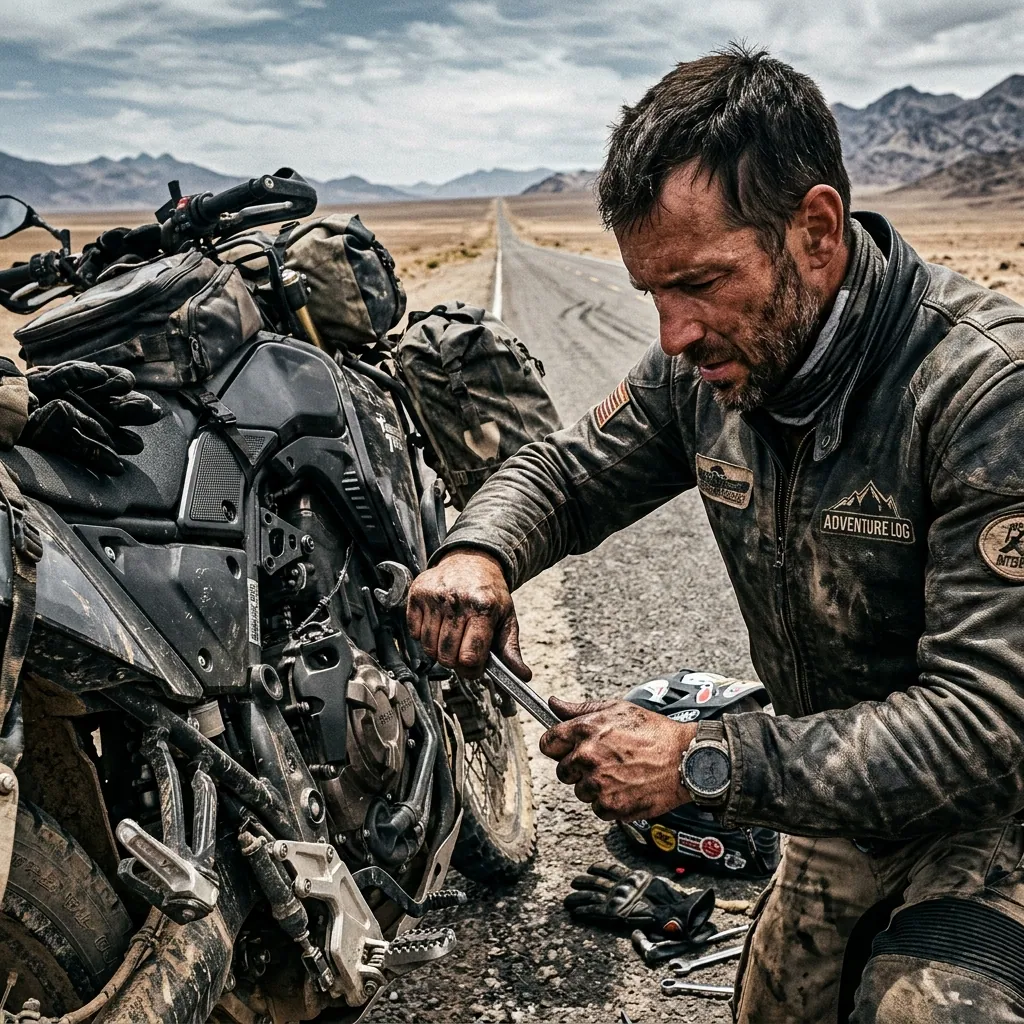
Forget 500-page workshop manuals. In the middle of a desert or a tropical jungle, only three things matter: air, fuel, and spark. If the bike won't start, one of those three is failing. Full stop.
The emergency mechanic doesn't chase technical perfection — they chase enough autonomy to reach civilization. The goal is to get the bike rolling, not to do a workshop-grade repair.
- ▶Listen to the symptom: Before touching anything, analyze what happened. Did it cut out suddenly (electrical)? Did it start misfiring intermittently (fuel)? Diagnosis saves more time than brute force.
- ▶Know your limits: Touching something you don't know how to fix is the fastest way to turn a small problem into a terminal one. If you don't know what a part is, don't take it apart.
2. Daily preventive check: The 1-minute routine
Preventive mechanics saves lives. Most serious breakdowns on the road started as something loose that nobody caught in time.
Adopt the "Before Coffee Rule": every morning, before you mount up, run this 60-second visual check:
| Item | What to look for | Time |
|---|---|---|
| Chain | Tension and lube (it shouldn't look like dry wire) | 10s |
| Tyres | Visual pressure check and no nails or cuts | 10s |
| Fluids | Oil and coolant levels (if applicable) | 15s |
| Bolts | Quick scan of pannier bolts and axles | 15s |
| Brakes | Pad thickness and lever feel | 10s |
It sounds trivial, but catching a slack chain or a loose pannier bolt at 8am saves you four hours of drama at noon.

3. The minimum viable toolkit (and the dead weight)
I've seen riders carrying more tools than a MotoGP team. The result? 10 extra kilos that stress the engine and crack the subframe. Don't carry anything you don't know how to use.
Start with the factory tool kit and add quality where it counts:
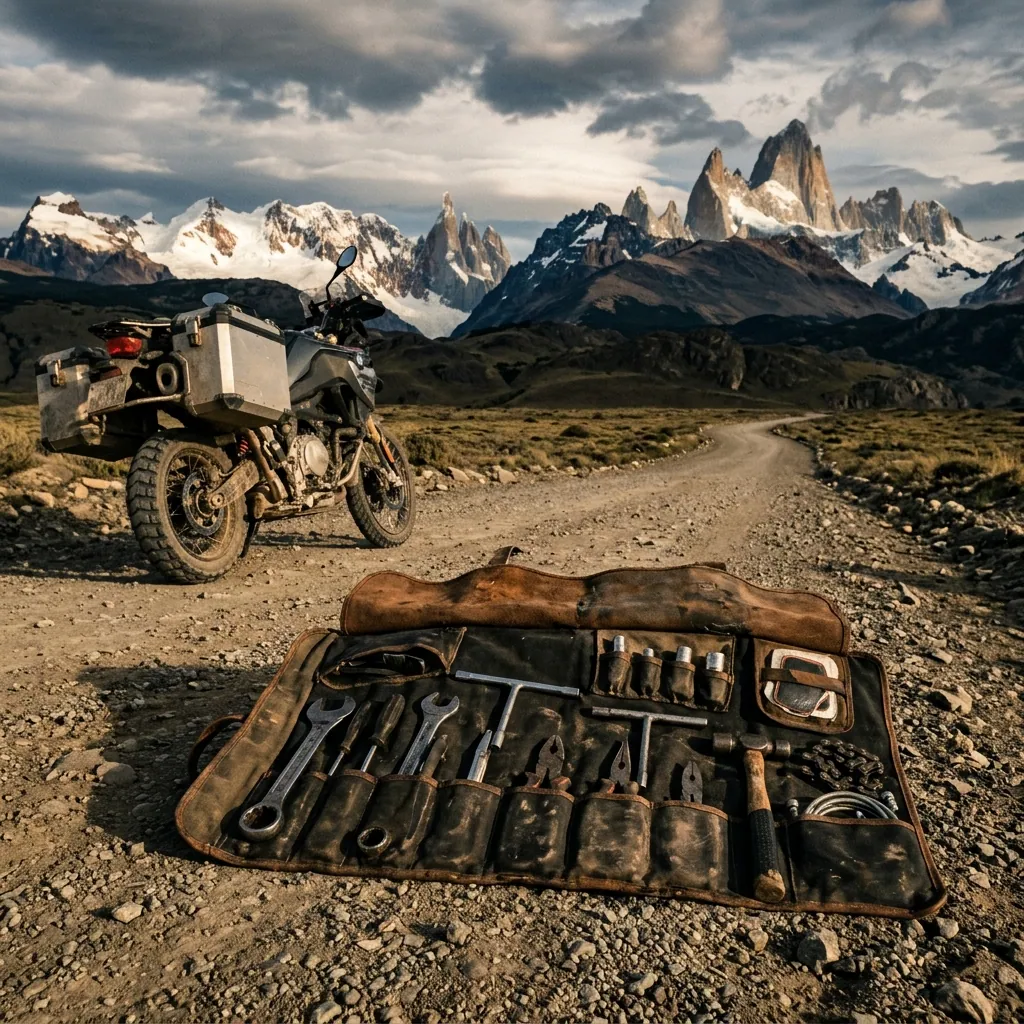
- The Rescue Kit: Socket and box wrenches for your axles, Allen keys for plastics, a reversible screwdriver, and a needle-nose plier.
- War Consumables: Lots of zip-ties, a small WD-40, quality duct tape, soft wire, and cold weld epoxy (like JB Weld).
- The Road God: The puncture repair kit. If you can't patch a tyre, you don't know how to ride long distance. It's the most likely breakdown and the easiest to fix.
A metre of duct tape and a handful of zip-ties have saved more trips than every roadside assistance plan on earth.
4. Common breakdowns and survival diagnostics
When the bike fails, your instinct says it's the engine. It almost never is.
Punctures: The daily bread
If the bike starts weaving or the steering feels heavy, stop. Don't try to reach the next gas station — you can blow the bead off the rim and destroy the wheel. Put the bike on the centre stand (or find a rock to prop it) and look for the object. Mark the spot before pulling it out.
Dead battery: The silent killer
If the lights are dim when you turn the key or the starter makes a click-click sound, it's the battery. Before panicking, check that the terminals haven't worked loose from vibration (classic on gravel roads). If they're tight, you're push-starting or hunting for jump leads.
Broken or derailed chain
Usually happens from neglected maintenance. If it jumps off, check that it hasn't cracked the engine case. If it snaps, you need a master link (you should be carrying one in your kit). It's not hard to install but demands patience and dirty hands.
5. Fix it or ask for help? The risk boundary
There's a dangerous ego in the moto-traveler who thinks they must solve everything alone. Wrong move.
If you're on a main road, asking for help is a smart logistical decision. If you're in the middle of the steppe, fixing it is a survival necessity. The key question is: can I make this bike worse than it already is?
Connect this knowledge with comprehensive trip preparation before you leave. The better you know your bike in your own garage, the easier it is to decide when to wave the white flag on the road.
And remember: sometimes paying for a tow truck is cheaper than destroying an engine. Manage your finances carefully and master the logistics of your big trip so a breakdown doesn't end your adventure.
6. My grease baptism: The day I realized I knew nothing
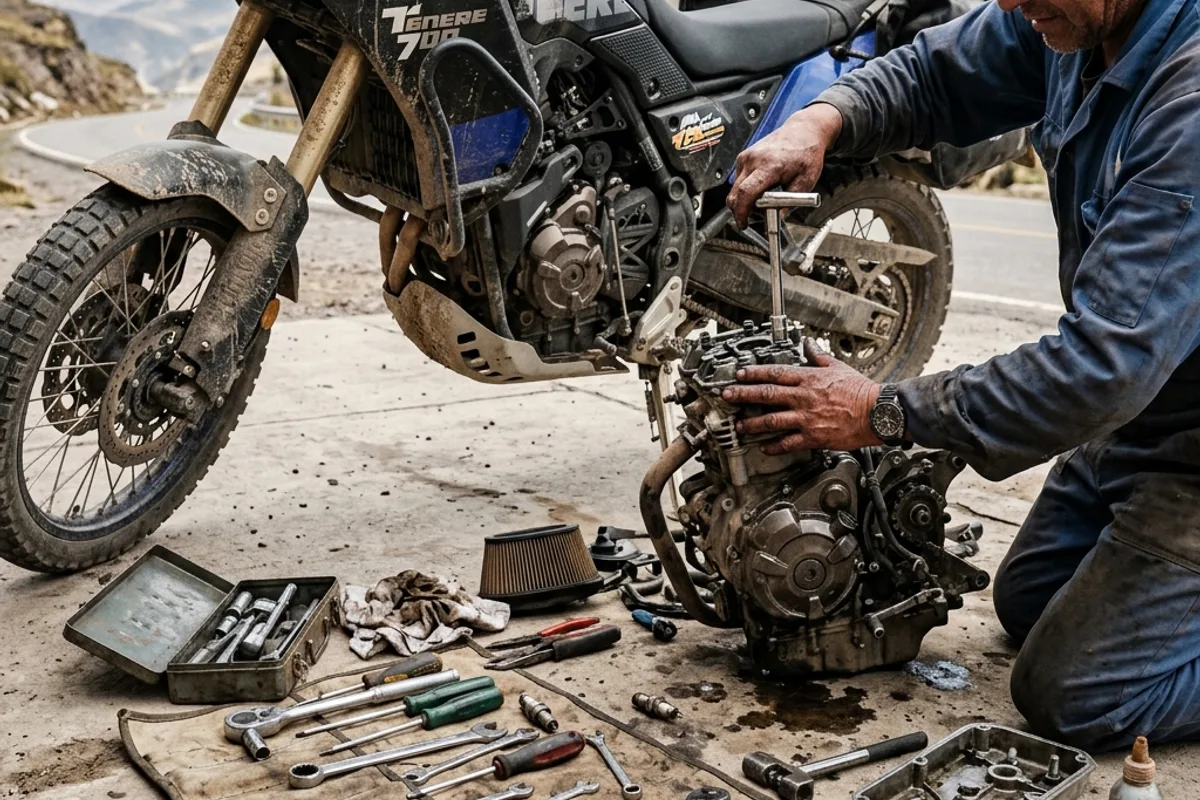
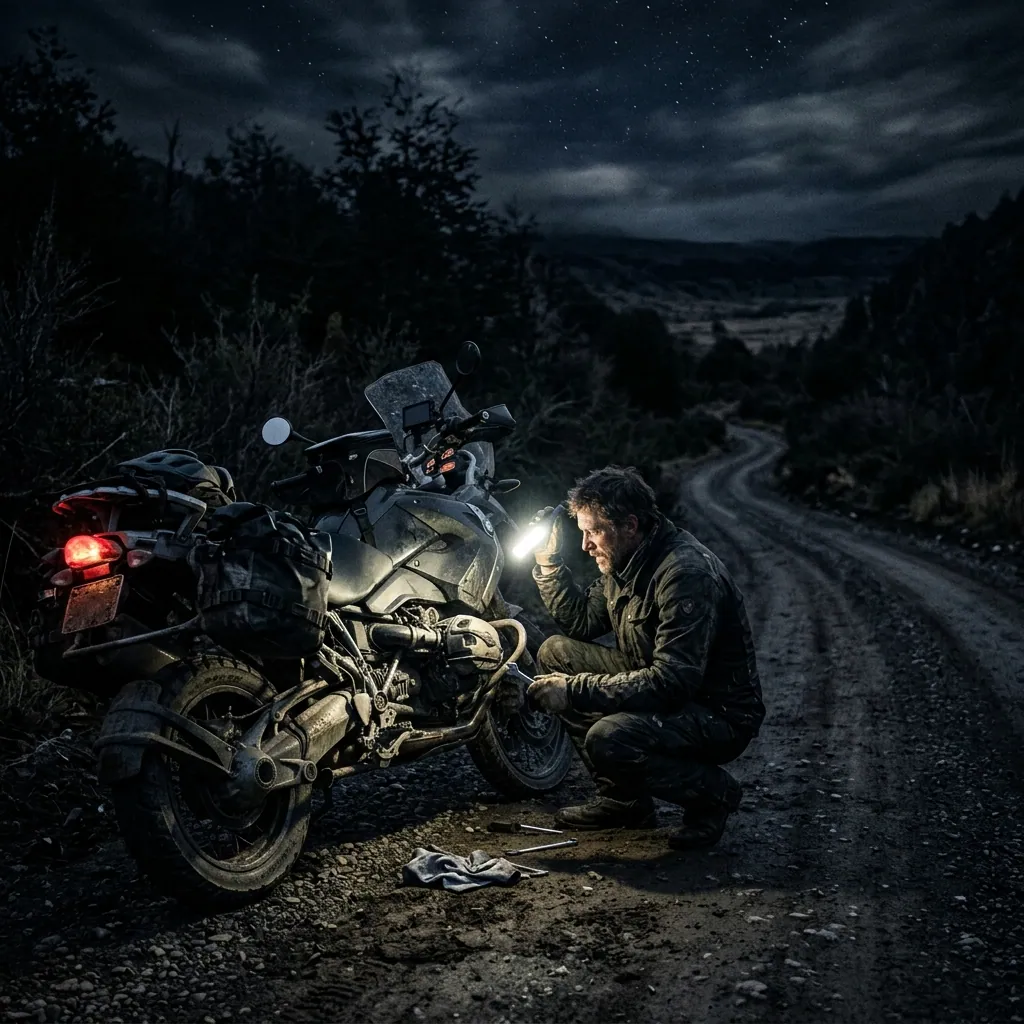
It was in northern Peru. The bike died climbing a mountain pass at 4,000 metres. No signal, freezing cold, and I was convinced the engine had blown. I pulled half the carburetor apart on the ground, covered myself in petrol, lost a bolt...
Want to know what it was? The spark plug cable had worked loose from the vibration on the gravel road. Two seconds of work. But panic made me waste three hours and nearly destroy the bike by taking it apart without any logic.
That day I learned that motorcycle mechanics for long trips is a mental game. If you lose your cool, you lose the trip. Breathe, look at the obvious stuff first, and only then — only then — reach for the wrench.
If your route also climbs to 4,000 metres through northern Peru, the Peru motorcycle travel guide breaks down workshop and spare-part availability by region, so that kind of silence on the road doesn't catch you without a plan.
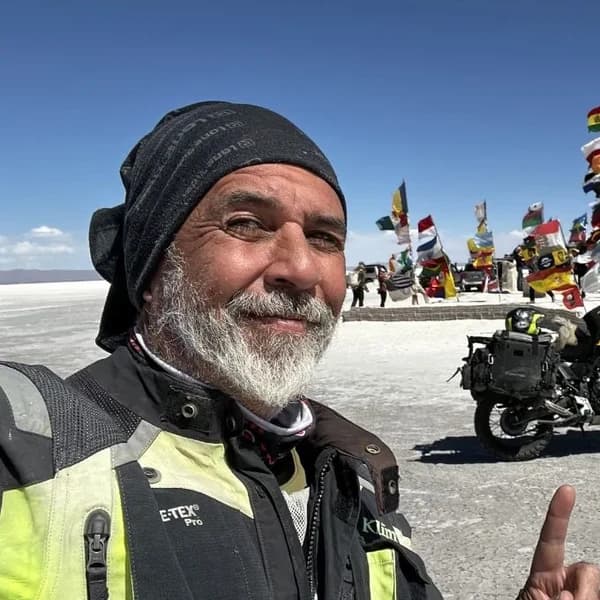
Gustavo Correa
Moto traveler, author and motorcycle travel consultant. 110,000+ km across 4 continents with Gloria, my motorcycle. Everything you read here has been tested on the road, not in an office.
Read my story →FAQ — FREQUENTLY ASKED QUESTIONS
Do you need to be a professional mechanic to ride long distance?
No. You just need to understand your bike's critical systems: how it brakes, how it starts, and how it transfers power. 90% of roadside problems are solved with basic logic and simple tools. Anything deeper, a shop will handle when you reach the next city.
What spare parts are mandatory to carry?
A patch kit/tire plugs, clutch/throttle cables (or repair kits), zip-ties, wire, and a spare fuse. Everything else is usually dead weight you can buy along the way — unless it's an ultra-specific part for your model.
How do I know if an engine noise is serious?
Golden rule: if the noise changes with RPMs or disappears when you pull the clutch, it's internal. If it's constant and rhythmic, something might be loose. If you hear metal on metal, kill the engine immediately. Everything else is usually rider paranoia.
Is it worth carrying an electric inflator?
Only if it's compact and robust. Otherwise, a quality foot pump or CO2 cartridges take less space and never die from a dead battery. Simplicity on the road is your best ally.
What do I do if something breaks that I can't fix?
You breathe. You assess whether the bike is safe to ride slowly. If not, you look for the nearest town. Local people are usually resourceful and have tools you can't even imagine. You're never as alone as you think.