MOTORCYCLE TRAVEL IN Uzbekistan
QUICK ANSWER
Uzbekistan is the heart of the Silk Road and one of the most rewarding stretches of crossing Central Asia by motorcycle: Samarkand, Bukhara, and Khiva connected by main roads in decent condition. Entry is straightforward — no Carnet de Passage is required (unlike Iran, the only country in the region that does ask for one), and the temporary import procedure at the border crossing itself is free. The real point of friction isn't the paperwork but the fuel: outside Tashkent it can run short, especially during the cotton harvest (September-October).
WHAT YOU NEED TO KNOW
The country you're about to enter has particularities you need to know.
Before you cross the border there are four things you need locked down: how safe the country is, what insurance is mandatory for your motorcycle, where you'll actually find fuel, and when to go. None of these are optional.
SAFETY: LOW RISK (2/5)
Is Uzbekistan safe to enter by motorcycle? Yes — it's one of the calmer countries in Central Asia, with the real risk concentrated in two specific border strips, not on the main routes.
AREAS TO AVOID
- Border strip with Afghanistan (Termez and surroundings): The UK government (gov.uk) flags a significant Uzbek military presence in the so-called 'neutral zone' by the Friendship Bridge, closed to foreigners, and notes that in April 2022 ISKP fired rockets from Afghan territory into southern Uzbekistan. Many sites in this strip require a permit from local authorities or an organized tour — it's not a zone to ride through on your own.
- Border crossings with Tajikistan: gov.uk documents an armed attack in 2019 on a checkpoint at the Tajikistan border that killed 17 people. Controls remain strict — cross during daylight, with all your paperwork in order, and don't leave the procedure for right before the crossing closes.
WHERE TO PARK
- Parking: Hotels and guesthouses on the tourist circuit (Tashkent, Samarkand, Bukhara, Khiva) usually have a gated courtyard or an arrangement with a nearby guarded lot — ask before booking. Elsewhere in the country, prioritize hotels with their own gate over leaving the bike on the street.
- Alarm: Not a common local fixture, so if your bike doesn't have a factory alarm, a disc lock is more of a deterrent than any electronic system in areas where nobody recognizes the siren.
- Luggage: Bag and backpack theft is the most cited crime by gov.uk, especially in bazaars and public transport — never leave it on the bike or at the hotel overnight. Bring your panniers with you or keep them inside the room at night.
- Visibility: Avoid leaving the loaded bike in plain sight in downtown Tashkent or in the bazaars of Samarkand and Bukhara during the day — they're the busiest tourist spots and, according to gov.uk, where pickpocketing concentrates.
TIPS
- ➜Avoid riding after dark outside the cities — gov.uk flags poor road surfaces and bad lighting, and it's the same advice local authorities give.
- ➜Police checkpoints are frequent, especially entering and leaving the Fergana Valley, but according to accounts gathered by Caravanistan they tend to be polite — always keep your passport, bike title, and temporary import declaration within reach.
- ➜Register your accommodation every night — it's still required, though in practice it no longer causes the problems it used to; keep your ticket if you sleep on a night train, to prove you couldn't register that night.
Uzbekistan is, in practice, one of the more manageable countries in Central Asia to enter by motorcycle: the real risk is confined to two specific border strips (Afghanistan and the crossings with Tajikistan), not the routes you'll actually ride. The rest is the same care you'd apply in any developing country — bike within sight, gated accommodation, and avoiding the road after dark.
MANDATORY INSURANCE: Local third-party liability insurance (not always required at entry)
Not mandatory to enter, but several riders report being asked for it when exiting the country, which can cause delays. There isn't always an insurance office right next to the border crossing — sometimes you have to find one in the nearest town. The cost is low, on the order of a few dollars for a couple of months of coverage. An international Green Card-type policy doesn't cover Uzbekistan, so it's worth buying local coverage as soon as possible.
FUEL: SCARCE OUTSIDE TASHKENT
Fuel is one of the biggest logistical challenges for a foreign motorcycle traveler in Uzbekistan, according to accounts gathered by Caravanistan. Around Tashkent and on the main routes it's not an issue, but it gets scarce the farther you get from the capital, especially in Karakalpakstan, and the situation worsens during the cotton harvest (September-October), when fuel is prioritized for agricultural machinery. On those stretches it's bought informally, in bottles by the roadside, of doubtful quality — carry a spare fuel filter. Diesel is easier to find, even during harvest season. You can bring in up to 100 liters of your own fuel with no known restrictions, so if your bike has an auxiliary tank or you can carry jerry cans, that's the best insurance.
BEST SEASON: APR-MAY & SEP-OCT
Spring (April-May) and fall (September-October) are the best window: mild temperatures, and the same stretch that concentrates most of the country's festivals. Summer (June-August) tops 40°C in the Kyzylkum desert, making daytime riding punishing — better to save that season for the higher mountains of Kyrgyzstan or Tajikistan. Winter brings below-freezing temperatures in the center of the country and even colder further west, with fewer tourists but also less open infrastructure.
ENTERING UZBEKISTAN BY MOTORCYCLE
Crossing into Uzbekistan with your own motorcycle is, according to accounts gathered by Caravanistan (the most-cited reference for overlanding in Central Asia), one of the less bureaucratic procedures in the region: it doesn't require a Carnet de Passage en Douane — unlike Iran, the only nearby Silk Road country that does — and temporary import is sorted out at the border crossing itself.
The procedure has two steps:
Immigration: Stamps your passport on entry. Check beforehand whether your nationality needs an e-visa (e-visa.gov.uz, USD 20, 2-3 business days) or falls into the group of roughly 60 countries with visa-free entry, most for up to 30 days.
Customs: Declares the motorcycle and completes the temporary import — no carnet or deposit involved, it's free, and there's no minimum vehicle age requirement.
Temporary import of the motorcycle costs nothing at the border — Uzbekistan doesn't require a Carnet de Passage en Douane (the expensive exception in the region is Iran, not Uzbekistan), so there's no deposit or bank guarantee to leave anywhere.
Insurance is the gray area
Unlike Kyrgyzstan, where third-party insurance has been mandatory (if loosely enforced) since 2016, Uzbekistan doesn't require it to enter — but several riders report on Caravanistan being asked for it when exiting the country, which can cause delays. The catch is that there isn't always an insurance office right next to the border crossing — you may have to find one in the first sizeable town. Buy it as soon as you cross, before heading further.
Fuel, not paperwork, is the real challenge
Caravanistan sums it up plainly: fuel is a big issue for foreign drivers in Uzbekistan. It runs short outside Tashkent, especially in Karakalpakstan, and gets worse during the cotton harvest (September-October), when the government prioritizes fuel for agricultural machinery. On those stretches it's bought informally, in bottles by the roadside — of doubtful quality, so travel with a spare fuel filter. Diesel, by contrast, is available almost everywhere.
REQUIRED DOCUMENTATION
Valid passport: With at least 6 months of remaining validity, as at most borders in the region.
E-visa or visa exemption depending on nationality: About 60 countries enter visa-free, most for up to 30 days; everyone else applies for the e-visa at e-visa.gov.uz (USD 20, 2-3 days).
Driving license: The national license is enough in practice; an international permit helps but checkpoints rarely ask for it, according to Caravanistan's accounts.
Motorcycle ownership title: Or a notarized power of attorney if the bike isn't registered in your name.
Temporary import declaration: Issued by Customs at the border crossing itself, free of charge and without a carnet.
Local third-party liability insurance: You're not always asked for it on entry, but it's worth buying as soon as you cross — see the insurance section below.
A procedure simpler than its reputation
Uzbekistan has a reputation for red tape from its Soviet past, but for a motorcycle traveler the crossing is one of the lightest in Central Asia: no Carnet de Passage, no deposit, no age limit on the vehicle. The real challenge starts after the border — finding reliable fuel and sorting out the right insurance — not at the crossing itself.
DAILY BUDGET
This price range combines cheap lodging, cooking your own meals, and basic bike maintenance — the three categories that weigh most on any moto traveler's daily budget.
Your real daily budget is something you build yourself, based on your own needs and limits — but if you want an idea of how to build yours, pick a category to see the full guide:
Full cost breakdown in the budget guide
THE 10 BEST MOTORCYCLE ROUTES IN UZBEKISTAN
The order of this Top 10 is not arbitrary: it starts with the routes that the most international and local riders actually cover and document — the ones that show up again and again in motorcycle travel blogs, on forums like Horizons Unlimited and Adventure Bike Rider, and in the accounts of riders who have already crossed Uzbekistan on two wheels. The Great Silk Road tops the list because it is, without question, the backbone of any motorcycle trip through the country; from there the order steps down based on how often each route is cited in those sources, while every single one remains a real, recognized route — never a personal find nobody else has ridden.
Uzbekistan does not forgive improvisation: there are stretches of hundreds of kilometers of desert without a single fuel station, and summers that push past 40°C on the pavement.
Uzbekistan sits inside a corridor with active land borders into Kazakhstan, Kyrgyzstan and Tajikistan, so before setting out it's worth reviewingthe guide to documents for traveling internationally by motorcycle, so a border crossing doesn't catch you off guard on the customs carnet or the insurance paperwork.
And on stretches like the Kyzylkum desert or the border crossing toward Nukus, where there's no repair shop for hundreds of kilometers, it's essential to reviewthe mechanics guide for long motorcycle tripsbefore you leave, because a breakdown out there gets fixed with what you're carrying, or it doesn't get fixed at all.
The Great Silk Road:Tashkent, Samarkand, Bukhara and Khiva
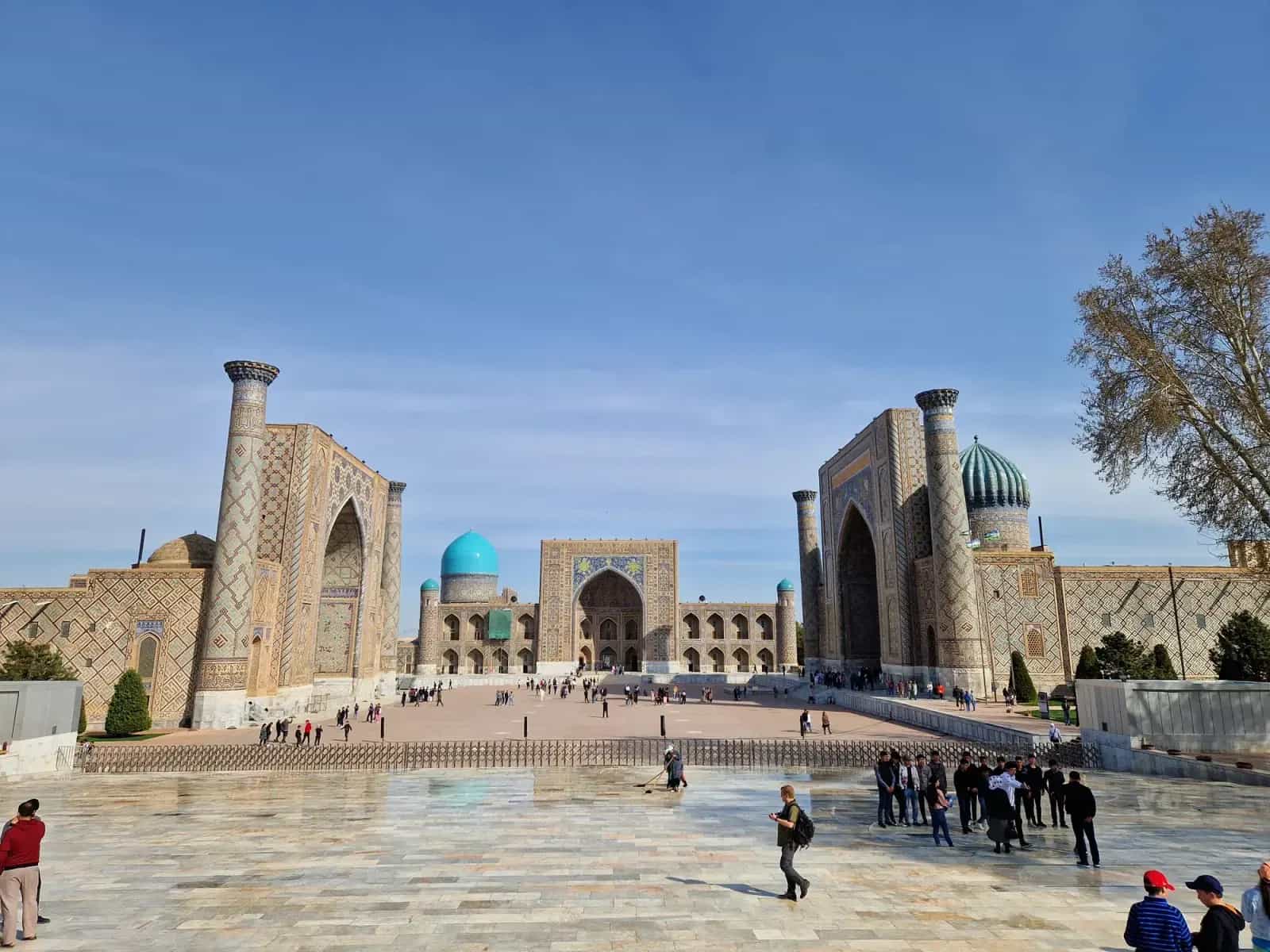
Tashkent to Khiva, via Samarkand and BukharaRiding the Great Silk Road by motorcycle means stringing together, in a single itinerary, the three urban jewels that made historic Uzbekistan famous: the Registan in Samarkand, the old town of Bukhara, and the walled city of Khiva.
Itchan Kala, Khiva's historic center, became Uzbekistan's first UNESCO World Heritage Site in 1990; Bukhara's historic center followed in 1993, and Samarkand — under the title "Crossroads of Culture" — joined in 2001.
It's the same alignment that Silk Road caravans used for over a thousand years to move silk, spices and knowledge between China, Persia and Europe, now a paved road a motorcycle traveler can ride in under a week.
The challenge isn't navigation — the four cities sit along a single main road — it's the distance and the heat: between Bukhara and Khiva the landscape turns to pure desert for hundreds of kilometers.
WARNINGS FOR THIS ROUTE
This is what you need to sort out before riding this route.
- 01Fuel range
Good in the four main cities. The Bukhara-Khiva stretch needs separate planning with a backup jerry can (see the next route).
Kyzylkum:the Desert Crossing between Bukhara and Khiva
Kyzylkum Desert, between Bukhara and KhivaCrossing the Kyzylkum Desert by motorcycle means tackling the stretch that separates two Silk Road oasis civilizations: Sogdian Bukhara and the ancient kingdom of Khwarezm, where Khiva now stands.
Kyzylkum means "red sand" and, at nearly 300,000 km², is one of the largest deserts in Central Asia — for centuries, crossing it by camel caravan was the most feared part of any trade route heading west.
Riders who have already covered this stretch describe it with the same recurring line: the asphalt looks perfect from a distance, and that's exactly how it catches people out, with deep craters capable of blowing a tire or bending an alloy rim.
There's no shade, no towns, and the heat is real: this is the stretch that decides whether a rider is genuinely ready for Central Asia.
WARNINGS FOR THIS ROUTE
This is what you need to sort out before riding this route.
- 01Fuel range
Critical. Hundreds of kilometers without reliable stations — fill up completely in Bukhara and carry a backup jerry can.
- 02Extreme heat and hidden potholes
Riders who documented this crossing report temperatures above 40°C on the asphalt and deep, well-disguised craters that have damaged tires and rims — slow down even when the road looks smooth.
Kamchik Pass:Tashkent to the Fergana Valley
Qurama Mountains, between Tashkent and the Fergana ValleyClimbing Kamchik Pass by motorcycle means crossing the only direct land route from Tashkent into the Fergana Valley without detouring through Tajikistan, at 2,268 meters above sea level deep in the Qurama Mountains.
For centuries it was part of the historic Silk Road alignment connecting Sogdiana with the agricultural Fergana Valley, and its old cliffside track — now partly bypassed by a modern tunnel — still tempts riders chasing the original route.
In winter the pass used to become impassable: heavy snowfall and the risk of avalanches and mudslides left both vehicles and nearby villages cut off, a factor that still shapes the ideal riding season today.
From the top, on a clear day, the snow-capped peaks of the Fan Mountains show up on the horizon.
WARNINGS FOR THIS ROUTE
This is what you need to sort out before riding this route.
- 01Fuel range
Good. Stations in Angren before the climb and in Kokand once you drop into the valley.
- 02Snow and avalanche risk in winter
The pass has historically been impassable in winter due to heavy snowfall, with documented avalanche and mudslide risk that also threatens nearby villages. Avoid crossing it outside the recommended season.
From Nukus to Moynaq:the Aral Sea
Nukus to Moynaq, KarakalpakstanReaching the Aral Sea by motorcycle from Nukus means riding toward one of the largest human-made ecological disasters of the 20th century.
Until the 1960s the Aral was the fourth-largest lake on the planet; the Soviet-era diversion of its two feeder rivers to irrigate cotton fields caused it to lose over 90% of its volume within a few decades, and today the real shoreline has retreated more than 100 km from Moynaq.
Moynaq was once a thriving fishing port, with an active fleet and a population in the tens of thousands; today, stranded on the sand of what used to be the seabed, ten to twelve rusting boats survive as the famous "ship graveyard."
It's a landscape unlike anything else on this route: riding in and seeing those iron hulls stuck in the middle of nowhere sums up, better than any statistic, what it means to dry up a sea.
WARNINGS FOR THIS ROUTE
This is what you need to sort out before riding this route.
- 01Fuel range
Fill the tank completely in Nukus — fuel availability in Moynaq is scarce and irregular, don't count on finding it there.
The Chimgan Mountains and Lake Charvak
Chatkal-Ugam Range, 120 km from TashkentRiding up the Chimgan Mountains by motorcycle is the escape every rider living in Tashkent makes the moment they get a free weekend.
The area is known as "Uzbek Switzerland" for its slopes covered in relict juniper forests and peaks topping 3,000 meters, a total contrast with the desert that dominates the rest of the country.
Lake Charvak, an artificial reservoir formed on the Chirchik River, has become the gathering point for the capital's motorcyclists and cyclists, with tight climbing curves that demand good technique before you reach the shore.
Along with the Silk Road route, this is the road local Uzbek riders cover the most on two wheels — proof you don't need to cross a desert to find a great ride in this country.
WARNINGS FOR THIS ROUTE
This is what you need to sort out before riding this route.
- 01Fuel range
Excellent. Full-service stations in Gazalkent and Chimgan along the entire route from Tashkent — not a real risk on this route.
The Desert Crossing:Beyneu to Nukus
Kazakhstan border to Nukus, KarakalpakstanRiding the desert crossing between Beyneu and Nukus by motorcycle is, for anyone entering Uzbekistan from the north, the toughest land gateway into the country.
It's nearly 640 km over what were once caravan routes of the ancient kingdom of Khwarezm, now a paved road that visibly deteriorates the farther it gets from the Kazakh border.
Riders who have already crossed it describe the same thing over and over: the asphalt looks perfect from a distance, and that's exactly how it catches people out, with deep craters capable of blowing a tire or bending an alloy rim in seconds.
There's no shade, almost no traffic, and the distances between towns are measured in hours, not kilometers — this is the stretch that separates riders who just want to see Samarkand from those who actually came to cross Central Asia on two wheels.
WARNINGS FOR THIS ROUTE
This is what you need to sort out before riding this route.
- 01Fuel range
Critical. No reliable stations for hundreds of kilometers — fill up in Beyneu, with only one mid-route station logged by other travelers, and carry a backup jerry can.
- 02Hidden craters that damage tires and rims
Riders who have documented this stretch report the road looks fine from a distance but hides deep potholes capable of blowing a tire or bending a rim — slow down considerably, especially near dusk.
The Nurata Desert and Lake Aydarkul
Kyzylkum Desert, near Nurata, Navoi RegionCrossing the Nurata Desert by motorcycle to reach Lake Aydarkul means leaving the Silk Road cities behind to enter the real Kyzylkum, the one still crossed by shepherds with camels.
In the town of Nurata, local tradition credits the ruins of an ancient fortress to Alexander the Great's campaign through the region, next to a sacred spring where fish swim that no one ever catches.
Lake Aydarkul, now one of Uzbekistan's largest bodies of water, didn't even exist as such until 1969: it was born when floodwater from a reservoir in the Syr Darya basin overflowed into a natural desert depression, and the water never fully receded.
Today, the sand track leading to the yurt camps is, for many riders, the first real taste of off-road riding on dunes in their entire Uzbekistan trip.
WARNINGS FOR THIS ROUTE
This is what you need to sort out before riding this route.
- 01Fuel range
Fill the tank completely in Nurata — there are no stations inside the desert, and loose sand spikes fuel consumption.
Takhtakaracha Pass:Samarkand to Shahrisabz
Zeravshan Range, between Samarkand and ShahrisabzRiding Takhtakaracha Pass by motorcycle is the most direct way to go from Tamerlane's imperial capital to his hometown.
The M39 highway climbs the Zeravshan Range to connect Samarkand with Shahrisabz, the historic Kesh where Timur was born between the late 1320s and 1336, and which he always considered his true home even while ruling from Samarkand.
In Shahrisabz, the monumental ruins of the Ak-Saray Palace await, and the city's historic center was declared a UNESCO World Heritage Site in 2000 — though it has been on the endangered list since 2016, after entire neighborhoods of the medieval layout were demolished to build a tourist park.
It's a short route, but with genuinely tight curves — the kind of mountain saddle best crossed in daylight.
WARNINGS FOR THIS ROUTE
This is what you need to sort out before riding this route.
- 01Fuel range
Good. Stations at both ends, in Samarkand and Shahrisabz — not a real risk on this route.
The Iron Gate:Samarkand to Termez
Buzgala Gorge, near Baysun, Surkhandarya RegionCrossing the Iron Gate by motorcycle means passing through the point that, for over a thousand years, decided who controlled trade between Central Asia and the south.
The Buzgala Gorge — its modern name, known in antiquity and the Middle Ages as the Iron Gate — is a mere 3 km defile near Baysun that cuts the only practicable route between Samarkand and Balkh (in present-day Afghanistan), already named in the Orkhon inscriptions of the Göktürk Empire in the 730s.
Controlling this pass meant controlling the Silk Road between Sogdia and Bactria; centuries later, travelers such as the Chinese Buddhist monk Xuanzang crossed it on the way to India and left written testimony of its strategic importance.
The road ends in Termez, a city on the banks of the Amu Darya that was for centuries a Buddhist center and today is the land gateway to Afghanistan — and one of the most extreme-heat towns anywhere in Uzbekistan.
WARNINGS FOR THIS ROUTE
This is what you need to sort out before riding this route.
- 01Fuel range
Fair. Stations in Shahrisabz, Kitab and Baysun; the final stretch into Termez is more isolated — don't set out with a half-empty tank.
- 02Extreme heat in Termez
Termez is documented as one of the hottest cities in Central Asia, with summers above 45°C — avoid riding during the midday hours between June and August.
Zaamin National Park
Turkestan Range, Jizzakh Region, near ZominRiding up into Zaamin National Park by motorcycle means entering Uzbekistan's oldest nature reserve, protected since 1926 as the Guralash Nature Reserve, on the northern slope of the Turkestan Range.
The road gains altitude fast, climbing from valleys at 1,700 meters to near Guralash Peak, at 3,571 meters, cutting through relict juniper forests that change color completely in autumn.
It's snow leopard and Turkestan lynx territory, inside a park that holds over 700 plant species and 150 bird species — the greenest, most mountainous contrast in the whole Top 10, against a country otherwise dominated by desert.
An old sanatorium built in the 1970s now serves as the visitor center, a landmark for anyone riding up in search of something different from the heat of the Kyzylkum.
WARNINGS FOR THIS ROUTE
This is what you need to sort out before riding this route.
- 01Fuel range
Fill the tank in Zomin or Jizzakh — there are no stations inside the park.
NEIGHBORING COUNTRIES
Crossing the border next? Click a country to see its 10 best motorcycle routes.
FREQUENTLY ASKED QUESTIONS
01Do I need a Carnet de Passage to bring my motorcycle into Uzbekistan?
+
Do I need a Carnet de Passage to bring my motorcycle into Uzbekistan?
No. Uzbekistan doesn't require it — across the whole Silk Road stretch through Central Asia, Iran is the big exception that does. Temporary import is sorted out for free at the border crossing itself, according to accounts gathered by Caravanistan.
02Do I need a visa to enter Uzbekistan by motorcycle?
+
Do I need a visa to enter Uzbekistan by motorcycle?
It depends on your nationality. Around 60 countries, including most of the EU, the UK, the US, Canada, and Australia, enter visa-free, most for up to 30 days. If your country isn't on that list, you apply for the e-visa at e-visa.gov.uz for USD 20, with 2 to 3 business days for issuance.
03Is insurance mandatory to enter Uzbekistan with a motorcycle?
+
Is insurance mandatory to enter Uzbekistan with a motorcycle?
It's not mandatory to enter, but several riders report on Caravanistan being asked for it when exiting the country, which can cause delays. Since there isn't always an insurance office right at the border crossing, the safest bet is to buy it as soon as you cross, in the first sizeable town.
04Where does fuel run short in Uzbekistan?
+
Where does fuel run short in Uzbekistan?
Outside Tashkent and the main routes, especially in Karakalpakstan, and it gets worse during the cotton harvest (September-October), when the government prioritizes fuel for agricultural machinery. Carry extra margin and, if your bike allows it, a spare jerry can.
05What's the best time to ride a motorcycle through Uzbekistan?
+
What's the best time to ride a motorcycle through Uzbekistan?
Spring (April-May) and fall (September-October), when temperatures are mild. Summer tops 40°C in the Kyzylkum desert, and winter drops below 0°C in the center of the country, with even colder temperatures in the western deserts.
06Is it safe to ride near the Uzbekistan border with Afghanistan or Tajikistan?
+
Is it safe to ride near the Uzbekistan border with Afghanistan or Tajikistan?
The strip along the Afghan border is a restricted military zone with a reinforced Uzbek presence — it's not a route to ride on your own. The crossings with Tajikistan are passable, but it's best to cross during daylight with your paperwork in order: gov.uk documents an armed attack on a border checkpoint in 2019 that killed 17 people.
07Is there an age limit for bringing a foreign-plated motorcycle into Uzbekistan?
+
Is there an age limit for bringing a foreign-plated motorcycle into Uzbekistan?
No. As a tourist temporarily importing your vehicle, there's no age restriction in any Silk Road country, according to Caravanistan. Some neighbors like Kyrgyzstan apply a small environmental fee at the border, but the sources consulted don't report that charge for Uzbekistan.
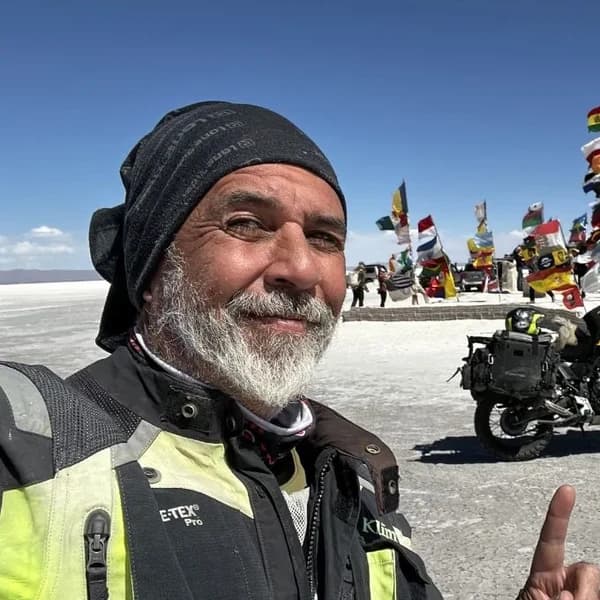
Gustavo Correa
Moto traveler, author and motorcycle travel consultant. 110,000+ km across 4 continents with Gloria, my motorcycle. Everything you read here has been tested on the road, not in an office.
Read my story →Last verified: 2026-08-30
A GIFT FOR BEING HERETHE ADVENTURE OF LIVING FREE
Do fear or doubt paralyze you before starting any project? You're not alone — every one of us has been there.
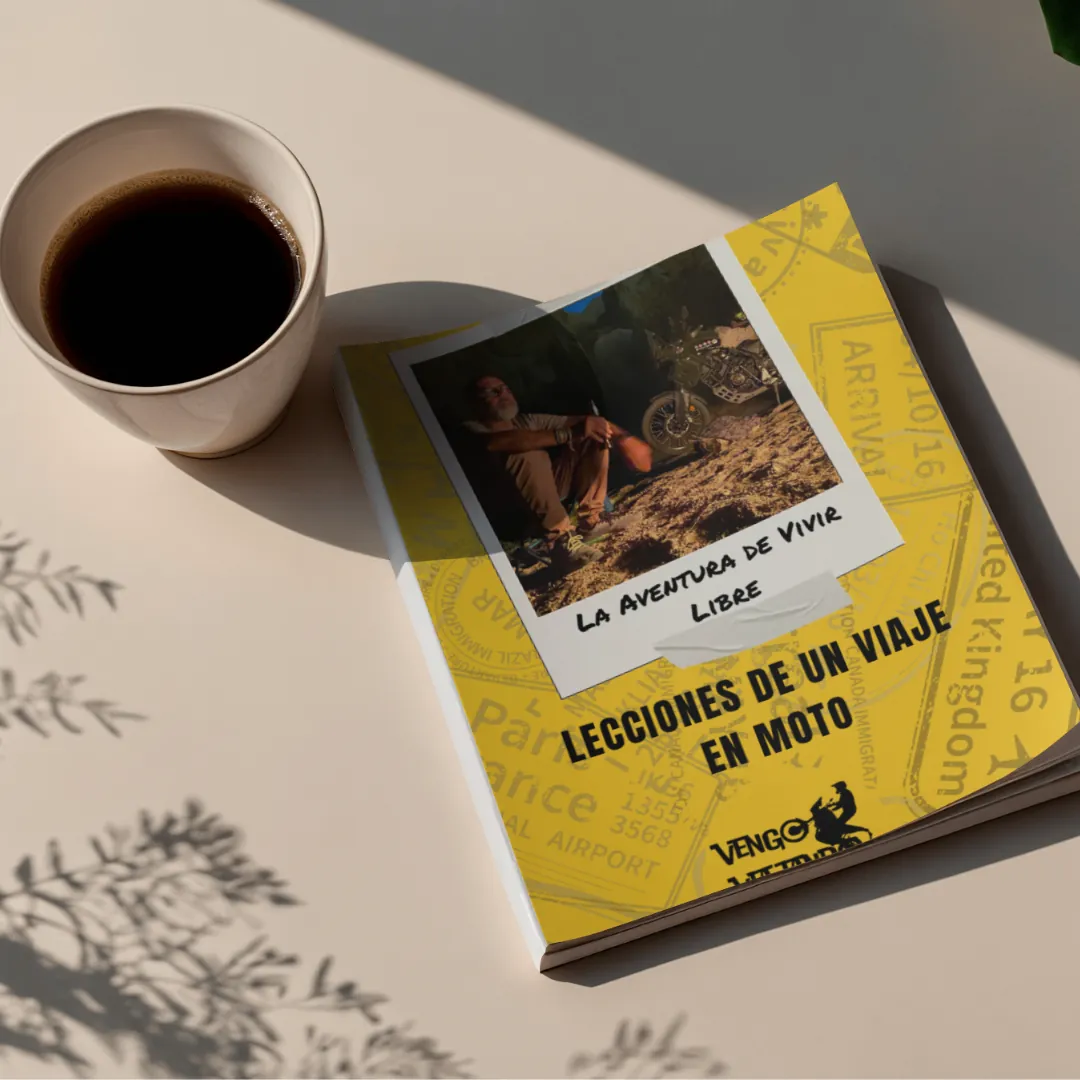
As a thank-you for visiting my site, I'm giving you my book "The Adventure of Living Free". A manual built to bring some light through the shadows and show you the philosophy that has let me ride the world for years.
* PDF STRAIGHT TO YOUR INBOX. NO SPAM.