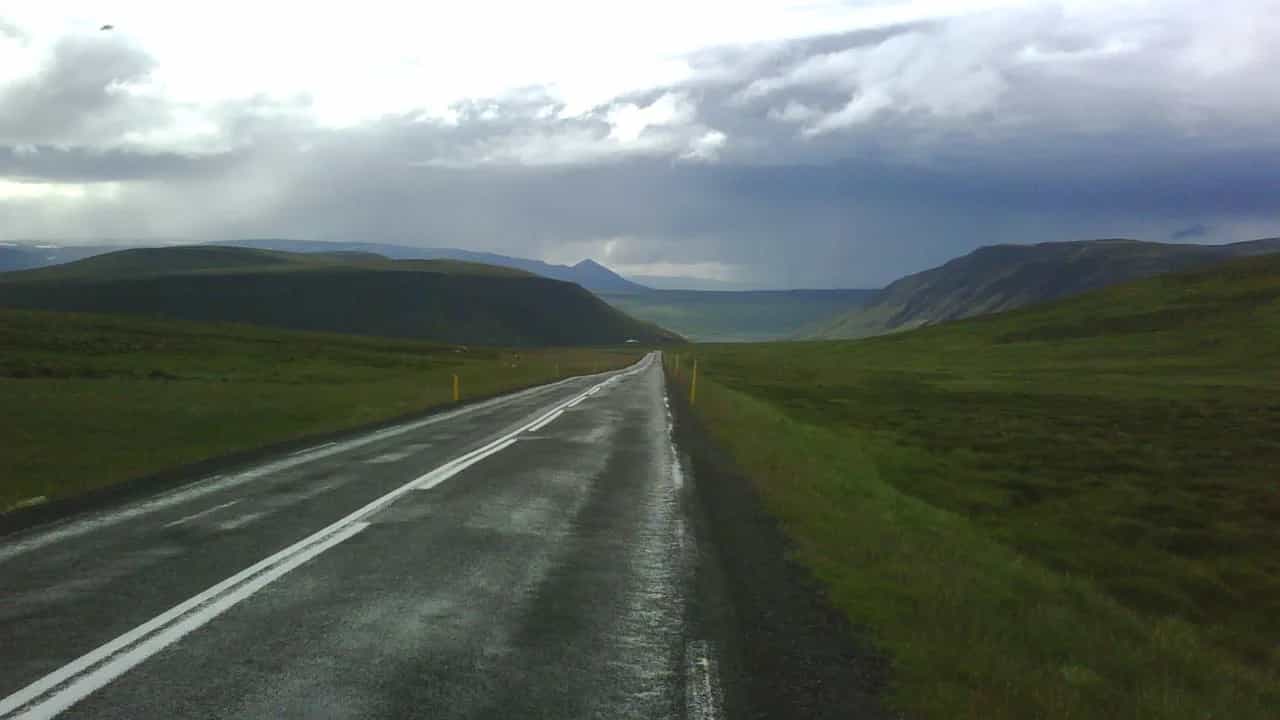
MOTORCYCLE TRAVEL IN Iceland
QUICK ANSWER
Iceland is ridden via the Ring Road (Route 1), the 1,309 paved kilometers that circle the whole island, with detours into the Westfjords and the highland F-roads for anyone chasing gravel and river crossings. You can't reach it overland — the only way in is Smyril Line's ferry from Denmark (via the Faroe Islands) to Seyðisfjörður, or shipping the bike as freight. Entry itself is the E-9 customs declaration, free and online, plus valid insurance — which any motorcycle registered in the EU or the EEA already carries.
WHAT YOU NEED TO KNOW
The country you're about to enter has particularities you need to know.
Before you cross the border there are four things you need locked down: how safe the country is, what insurance is mandatory for your motorcycle, where you'll actually find fuel, and when to go. None of these are optional.
SAFETY: VERY LOW RISK (1/5)
Is Iceland safe to enter by motorcycle? Yes — it has ranked as the world's most peaceful country in the Global Peace Index for 19 straight years, through 2026.
AREAS TO AVOID
- Golden Circle and South Coast viewpoints: Smash-and-grab theft from rental vehicles parked at tourist viewpoints is, according to 2026 reports, the country's most common property crime and it's rising. The same applies to panniers or a top case left in plain sight on a bike: never leave anything visible when you step off to take photos.
- Downtown Reykjavik at night: There are documented cases of theft from vehicles parked downtown (for example, across from the Canopy by Hilton hotel). Nothing serious compared to other European capitals, but don't leave luggage visible there either.
WHERE TO PARK
- Parking: Along the Ring Road and in small towns, any street spot is fine even overnight. In Reykjavik, avoid leaving it overnight in the downtown bar strip (Laugavegur) on weekends.
- Alarm: Not essential — motorcycle theft itself is very rare. A disc lock or chain is more useful for long stops at tourist viewpoints, where the real risk is what you're carrying, not the bike.
- Luggage: Take what you can carry (camera, electronics, documents) out of your panniers at every tourist stop — that's the documented theft risk, not overnight parking.
- Visibility: Park within sight of the café or gas station when you stop on a busy tourist route; in the empty interior this doesn't apply because there's simply no one around.
TIPS
- ➜Don't leave anything visible in your panniers or top case when you step away to walk to a viewpoint or waterfall, even for "just five minutes".
- ➜If you're arriving on the ferry from Denmark, keep your passport and the bike's paperwork, including the E-9 declaration, accessible but secured — customs control in Seyðisfjörður asks for them on disembarkation.
Outside those opportunistic thefts in tourist spots, Iceland is, by the numbers, the safest country on the planet to ride through.
MANDATORY INSURANCE: Green Card
Only mandatory for motorcycles registered outside the Green Card's free circulation zone, which covers the EU, the EEA, EFTA and a handful of other countries including the UK. If your bike is registered in one of those, your liability insurance is already treated as valid on arrival in Iceland, no extra paperwork. If not — for example a bike registered in the US or Canada — you need to present the Green Card, the international insurance certificate, at customs clearance.
FUEL: SCARCE IN THE HIGHLANDS
Good coverage along the Ring Road, with N1, Olís/OB and Orkan stations at reasonable intervals. On the F-roads of the interior there can be more than 100 km with no station at all — work out your bike's real range and carry a spare fuel canister before heading into the highlands. Every station is self-service and card-only, so bring more than one card.
BEST SEASON: JUN → SEP
June to September is the practical window: the Ring Road is rideable all through the northern summer, and the highland F-roads usually open between mid-June and September, depending on how long that year's snow takes to melt. Outside that window, much of the interior stays closed and the weather turns fast.
ENTERING ICELAND BY MOTORCYCLE
Iceland is an island: there's no land border crossing, so "entering by motorcycle" really means putting the bike on a passenger ferry or a cargo ship. The only passenger line that carries vehicles is Smyril Line, with its Norröna ferry from Hirtshals (Denmark) via the Faroe Islands to Seyðisfjörður, in the east of the country — a crossing of just over three days. Anyone who'd rather skip the ferry can ship the bike as freight with a carrier like Eimskip from Immingham (UK) or Rotterdam and fly in to Keflavík.
According to Iceland's Directorate of Customs (Skatturinn), the process itself has two parts:
E-9 declaration (online, before travel): Completed on the Customs (Skatturinn) website before you sail. A paper or digital copy must stay on the motorcycle for the whole stay.
Border control at the arrival port: On disembarking at Seyðisfjörður you present your passport, the motorcycle's title and valid insurance (a Green Card if applicable); the entry odometer reading is logged there.
The E-9 declaration is free — it's completed online on the Customs (Skatturinn) website and carries no processing fee.
Real friction point:it's not the paperwork, it's the ferry logistics. Smyril Line's Norröna sails from Denmark once a week in high season, and less often outside it, so you need to book months ahead and account for the crossing itself (a bit over three days) in your itinerary.
On top of that, the bike can stay in the country duty-free for up to 12 months, but a mandatory road fee based on the vehicle's weight applies either way: a fixed rate if you stay 30 days or less, and a per-kilometer charge if you stay longer — one more reason to have your itinerary sorted before you sail.
REQUIRED DOCUMENTATION
Passport or national ID: Valid for the whole stay. Iceland is a Schengen member; EU/EEA citizens can use a national ID card, everyone else needs a passport.
Driving license: Your home country's license is enough. An international driving permit is not required.
Motorcycle title/registration: If you're not the owner, you need notarized power of attorney from them.
E-9 declaration: Temporary vehicle import form. Completed online at skatturinn.is before you travel; a copy must stay on the bike at all times.
Valid insurance (Green Card if applicable): Motorcycles registered in the EU/EEA/EFTA are already treated as insured on arrival. Plates from outside that bloc must present a Green Card at customs control.
With these five points sorted, crossing into Iceland with a bike is mostly an exercise in planning dates: book the ferry months ahead, complete the E-9 before you sail, and confirm your insurance covers the country. Once you're on land, the process itself — unlike a land border crossing — is short.
DAILY BUDGET
This price range combines cheap lodging, cooking your own meals, and basic bike maintenance — the three categories that weigh most on any moto traveler's daily budget.
Your real daily budget is something you build yourself, based on your own needs and limits — but if you want an idea of how to build yours, pick a category to see the full guide:
Full cost breakdown in the budget guide
THE 10 BEST MOTORCYCLE ROUTES IN ICELAND
This ranking is ordered by real fame and popularity, from highest to lowest: at the top are the routes that anyone researching "motorcycle route Iceland" finds first, and that both Icelanders and visitors on rented bikes actually ride the most; further down, without being any less genuinely iconic, are the highland tracks (F-roads) that only a smaller group of adventure motorcyclists takes on, given their short season and technical demands.
Iceland has a quirk that doesn't exist in South America: the mountain tracks called F-roads (marked with an "F" prefix followed by a number, like F35 or F26) require crossing glacial-melt rivers that no insurance covers, and are open barely three or four months a year. That's why, even though they're the routes most talked about in adventure motorcycle forums, they sit in the second half of this ranking: a far smaller share of riders actually covers them compared to the Ring Road or the Golden Circle.
Before heading out on any of these routes, it's worth reviewingthe gear guide for long motorcycle trips, because in Iceland the weather can flip from sunshine to horizontal rain within the same hour, even in the middle of summer.
And if your plan includes any of the highland F-road tracks, it's essential to reviewthe mechanics guide for long motorcycle trips, because there's no repair shop or phone signal for hours in Iceland's interior.
It's also worth understanding whatmotorcycle travel insurancedoes and doesn't cover before fording a river on the F35 or the F88, because no Icelandic policy pays out for river-crossing damage.
The Ring Road:Route 1 circling all of Iceland
All of IcelandRiding the Ring Road by motorcycle means closing the most famous loop in world motorcycle travel: 1,309 km of Route 1 connecting every region of Iceland without a single gap, ever since the road was fully paved in 1974 to mark the island's 1,100th anniversary of settlement.
The route crosses glacial outwash plains still prone to jökulhlaups (sudden floods triggered by eruptions under the ice) and still keeps 31 single-lane bridges, a leftover from an era when crossing each river meant building a full structure.
It is not a technical route — it is a route of endurance and scenery. In a single day you can go from a black volcanic canyon to a green fjord to a moss-covered lava field, without ever leaving the pavement.
WARNINGS FOR THIS ROUTE
This is what you need to sort out before riding this route.
- 01Fuel range
Good overall, with stations in every town, though in the southeast and the Eastfjords stretches between pumps can exceed 100 km.
- 02Single-lane bridges
Route 1 still has 31 single-lane bridges, down from about 60 in 2010. Whoever reaches the bridge first has the right of way; slow down early, since a blind curve often hides them until the last moment.
The Golden Circle:Þingvellir, Geysir and Gullfoss
Suðurland (southern highlands), an hour from ReykjavíkRiding the Golden Circle by motorcycle is the first route almost every motorcycle traveler in Iceland does, and the reason is geological before it's touristic.
The loop links three sites that sum up the whole country: Þingvellir, where the rift between the North American and Eurasian tectonic plates literally splits the ground open (Iceland's parliament, the Althing, was founded here in 930); the Haukadalur geothermal field, where the Strokkur geyser erupts every 5 to 10 minutes; and Gullfoss waterfall, which drops in two stages into a 32-meter canyon.
Þingvellir was named a UNESCO World Heritage Site in 2004, and in the Silfra fissure inside the same park, glacial meltwater is so clear that visibility exceeds 100 meters underwater.
It's the least technically demanding route on this list, but no Iceland motorcycle itinerary is considered complete without it.
WARNINGS FOR THIS ROUTE
This is what you need to sort out before riding this route.
- 01Fuel range
Excellent. Stations in Selfoss, Laugarvatn and Reykholt along the whole loop.
The South Coast:from Seljalandsfoss to Jökulsárlón
Suðurland, along Route 1 between Reykjavík and HöfnRiding the South Coast by motorcycle covers Iceland's most photographed stretch, and for good reason: in under 400 km you pass Seljalandsfoss (a 60-meter fall you can walk behind) and Skógafoss, the same height, where legend says the first Viking settler hid a treasure chest in the cave behind the water.
Farther east, the black sand beach of Reynisfjara shows off hexagonal basalt columns and the Reynisdrangar sea stacks, but it's also one of the country's most dangerous spots: between 2007 and 2025, six deaths were recorded there from sneaker waves that surge inland without warning.
The stretch ends at Jökulsárlón, Iceland's deepest glacial lagoon (284 meters), which only formed in the 1930s when the Breiðamerkurjökull glacier began retreating, and has quadrupled in size since the 1970s. Its icebergs wash up on nearby Diamond Beach, the setting for four Hollywood films, including two James Bond movies.
WARNINGS FOR THIS ROUTE
This is what you need to sort out before riding this route.
- 01Fuel range
Good. Stations in Hvolsvöllur, Vík and Höfn at regular intervals.
- 02Sneaker waves at Reynisfjara
Between 2007 and 2025, six deaths were recorded on the black sand beach of Reynisfjara from waves that surge inland without warning. If you stop to photograph the bike by the shore, never turn your back on the sea, and respect the color-coded warning signs.
Snæfellsnes Peninsula:Iceland in Miniature
Vesturland, west of BorgarfjörðurLooping the Snæfellsnes Peninsula by motorcycle is the go-to day trip for riders who don't have time for the full Ring Road, because it packs almost every Icelandic landscape into 220 km.
The skyline is dominated by the Snæfellsjökull glacier-volcano, 1,446 meters tall, visible from Reykjavík on clear days and famous since 1864 as the entrance Jules Verne chose for Journey to the Center of the Earth.
The area around the volcano has been a national park since 2001 and in 2025 earned UNESCO Biosphere Reserve status; it was also, in 2008, the first region in Iceland and in Europe certified as a sustainable destination by EarthCheck.
Between the fishing villages of Arnarstapi and Hellnar, the route hugs basalt cliffs and seabird colonies before closing the loop along the peninsula's north coast.
WARNINGS FOR THIS ROUTE
This is what you need to sort out before riding this route.
- 01Fuel range
Good. Stations in Stykkishólmur, Ólafsvík and Grundarfjörður.
The Diamond Circle:Mývatn, Dettifoss and Húsavík
Norðurland eystra, north IcelandRiding the Diamond Circle by motorcycle is the northern version of the Golden Circle, with the advantage of still seeing only a fraction of its tourist traffic.
The loop circles Lake Mývatn, formed about 2,300 years ago by a basaltic eruption and nicknamed "midge lake" for the swarms of midges that appear in summer; on its south shore, the Skútustaðir pseudocraters are a textbook example of steam explosions over waterlogged sediment.
The other highlight is Dettifoss, dropping 44 meters over a 100-meter width, considered the second most powerful waterfall in Europe after the Rhine Falls, and the setting for the opening scene of the film Prometheus (2012).
The loop closes in Húsavík, Iceland's whale-watching capital, with the active Krafla volcano visible on the horizon for most of the ride.
WARNINGS FOR THIS ROUTE
This is what you need to sort out before riding this route.
- 01Fuel range
Good. Stations in Reykjahlíð (Mývatn), Húsavík and Ásbyrgi.
The Westfjords:the remote circuit of Iceland's fjords
Vestfirðir, northwest IcelandRiding the Westfjords loop by motorcycle is the trip most adventure motorcyclists name as Iceland's best, precisely because it's the country's least visited region: just 7,341 residents across 8,842 km², the lowest population density in Iceland.
The coastline is so cut up by fjords that the roads turn slow and winding — every bay forces a full detour — until the Vestfjarðagöng tunnel, opened in 1996, finally shortened the distance between Ísafjörður and its neighboring towns.
At the western tip, the Látrabjarg cliffs form the largest bird cliff in the North Atlantic and mark Iceland's westernmost point; the region is also home to the country's largest Arctic fox population and to Drangajökull, the only glacier in the Westfjords.
It's the route on this list that demands the most self-sufficiency: hours can pass between fjords without a single town in between.
WARNINGS FOR THIS ROUTE
This is what you need to sort out before riding this route.
- 01Fuel range
Fair. Ísafjörður is the only sizeable hub; between small villages, stretches without a station can exceed 100 km.
The Kjölur Route (F35):the first highland crossing
Central highlands, between Gullfoss and VarmahlíðCrossing the Kjölur route by motorcycle is, for most riders, the gateway into Iceland's highlands: it's the country's most-traveled F-road because it connects south and north through the interior without the more dangerous fords found on other tracks.
The road runs across a plateau at 600-700 meters between two glaciers, Langjökull and Hofsjökull, historically marked with stone cairns (vörður) that guided travelers since the early settlement period, when the route was already mentioned in the Icelandic sagas.
In the 18th century, a snowstorm killed a group of travelers mid-crossing and the route fell out of use for nearly a century, only being rediscovered in the 1800s.
Halfway along, the Hveravellir hot springs — where, according to tradition, the outlaw Fjalla-Eyvindur once hid — remain a warm oasis today in the middle of a volcanic stone desert.
WARNINGS FOR THIS ROUTE
This is what you need to sort out before riding this route.
- 01Fuel range
None along the plateau stretch. Fill up at Gullfoss or in Bláskógabyggð before climbing; the next pump is at Varmahlíð, already in the north.
- 02No insurance covers river fords
According to Safetravel, Iceland's official road-safety agency, no insurance covers vehicle damage while crossing a river. Always cross in first gear without changing speed mid-ford, and never attempt it if the current looks uncertain.
Landmannalaugar:the rhyolite mountains via the F208
Fjallabak Nature Reserve, southern highlandsReaching Landmannalaugar by motorcycle means entering the northern end of the Laugavegur trail, Iceland's most famous hike, but through the door motorcyclists use: 90 km of F208 or F225 track along the edge of the Laugahraun lava field, formed by an eruption around 1477.
The landscape is unique in the country for its color: rhyolite mountains ranging from pink to green to ochre, the result of a volcanic composition different from the black basalt that dominates the rest of Iceland.
On arrival, natural hot springs allow for a warm soak in the middle of a mountain desert, and since 2024 access to the parking area has required a reservation because of how much traffic the site now receives each season.
It's one of the routes most cited in adventure motorcycle forums for tricky river crossings: the fords change depth from one day to the next depending on the meltwater.
WARNINGS FOR THIS ROUTE
This is what you need to sort out before riding this route.
- 01Fuel range
None at Landmannalaugar. The last station is in Hella or Hvolsvöllur, on Route 1.
- 02No insurance covers river fords
According to Safetravel, Iceland's official road-safety agency, no insurance covers vehicle damage while crossing a river. Always cross in first gear without changing speed mid-ford, and never attempt it if the current looks uncertain.
Sprengisandur:the desert crossing of the interior
Central highlands, between Hrauneyjar and GoðafossCrossing Sprengisandur by motorcycle means repeating the route Icelanders themselves avoided during the Commonwealth period (930-1262), when it was one of the few direct paths to Þingvellir but required crossing hundreds of kilometers of desert with no fodder for horses and no settlements along the way.
The name combines "sandur" (volcanic sand desert) and "sprengja" (to burst a horse from hard riding): medieval travelers had to gallop flat out to avoid running out of supplies halfway across.
Today the Sprengisandsleið track runs between the Hofsjökull and Vatnajökull glaciers through a lunar landscape of black ash, and only a tourist bus covers it in summer, every other day, between Landmannalaugar and Mývatn.
Along with Askja, it's the route most cited in motorcycle-travel forums as "the real Sprengisandur" — the crossing that separates the tourist from the adventure motorcyclist.
WARNINGS FOR THIS ROUTE
This is what you need to sort out before riding this route.
- 01Fuel range
Critical. No stations along the whole crossing; fill up at Hrauneyjar before climbing and keep a reserve until Goðafoss or Mývatn.
- 02No insurance covers river fords
According to Safetravel, Iceland's official road-safety agency, no insurance covers vehicle damage while crossing a river. Always cross in first gear without changing speed mid-ford, and never attempt it if the current looks uncertain.
Askja:the crater where NASA trained, via the F88
Central highlands, northeast of VatnajökullReaching Askja by motorcycle means entering one of Iceland's most remote volcanic calderas, 100 km down the F88 track from Route 1, and the site where NASA trained 32 Apollo astronauts because of its resemblance to the lunar surface — commemorated today at the Astronaut Monument in Húsavík.
The caldera still holds the memory of the 1875 eruption, a VEI-5 event whose ash covered more than 5,000 km² and devastated livestock across much of the country.
Inside the crater, Lake Víti (Icelandic for "hell") was a warm geothermal lake right after the eruption; today it stays frozen most of the year, at 1,516 meters above sea level.
It's the most isolated route on this list and has the shortest season of all: access runs only from late June to early October, and even then there's zero margin for error on fuel.
WARNINGS FOR THIS ROUTE
This is what you need to sort out before riding this route.
- 01Fuel range
Critical. Fill up at Möðrudalur or Grímsstaðir before taking the F88; there's no service at all along the 100 km track.
- 02No insurance covers river fords
According to Safetravel, Iceland's official road-safety agency, no insurance covers vehicle damage while crossing a river. Always cross in first gear without changing speed mid-ford, and never attempt it if the current looks uncertain.
FREQUENTLY ASKED QUESTIONS
01Can you enter Iceland by motorcycle overland?
+
Can you enter Iceland by motorcycle overland?
No. Iceland is an island with no land connection to any other country, so the only way to bring your own motorcycle is by sea: Smyril Line's Norröna ferry from Hirtshals (Denmark) via the Faroe Islands to Seyðisfjörður, or shipping it as freight with a carrier like Eimskip from Immingham or Rotterdam and flying in to Keflavík.
02Do I need a carnet de passage to enter Iceland?
+
Do I need a carnet de passage to enter Iceland?
No. Iceland does not require a carnet de passage — the equivalent process is the E-9 temporary vehicle import declaration, completed online on the Icelandic Customs (Skatturinn) website before you travel, at no cost.
03What insurance does my motorcycle need to enter Iceland?
+
What insurance does my motorcycle need to enter Iceland?
It depends on where it's registered. If it's from an EU, EEA or EFTA country, or another member of the Green Card's free circulation zone (which has included the UK again since 2021), your liability insurance is already accepted as valid on arrival. If it's registered outside that zone — for example in the US or Canada — you need to present a Green Card, the international insurance certificate, at customs control.
04When do Iceland's highland F-roads open?
+
When do Iceland's highland F-roads open?
There's no fixed date: they usually open between mid-June and September, depending on how long the snow takes to melt that year. The Icelandic Road Administration publishes the real status of each stretch on road.is before you head in.
05Is wind dangerous for riding a motorcycle in Iceland?
+
Is wind dangerous for riding a motorcycle in Iceland?
Yes, it's one of the country's real hazards: on exposed coastal and highland stretches, gusts can top 120 km/h and destabilize a loaded bike. Check the forecast on vedur.is or safetravel.is before riding each day, not just before the trip.
06How much does gasoline cost in Iceland?
+
How much does gasoline cost in Iceland?
It's among the most expensive in Europe: around 2.20 euros per liter in recent years. Every station is self-service and card-only — carry more than one card, since being unable to pay in an area with no coverage is a bigger problem than the price itself.
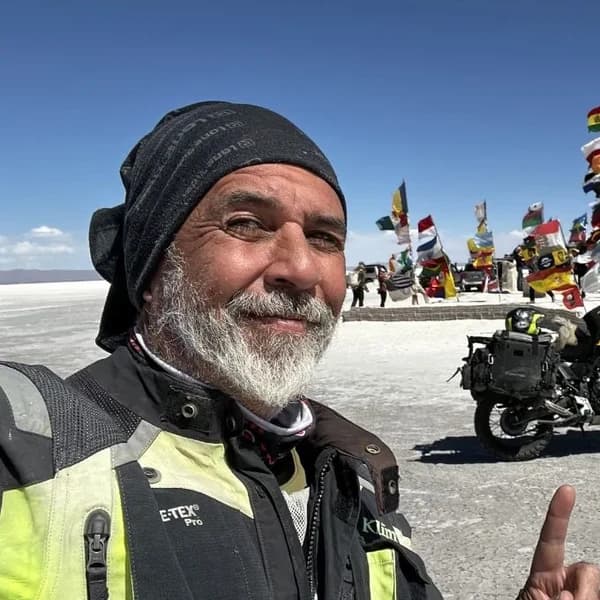
Gustavo Correa
Moto traveler, author and motorcycle travel consultant. 110,000+ km across 4 continents with Gloria, my motorcycle. Everything you read here has been tested on the road, not in an office.
Read my story →Last verified: 2026-08-29
A GIFT FOR BEING HERETHE ADVENTURE OF LIVING FREE
Do fear or doubt paralyze you before starting any project? You're not alone — every one of us has been there.
As a thank-you for visiting my site, I'm giving you my book "The Adventure of Living Free". A manual built to bring some light through the shadows and show you the philosophy that has let me ride the world for years.
* PDF STRAIGHT TO YOUR INBOX. NO SPAM.