MOTORCYCLE TRAVEL IN South Africa
QUICK ANSWER
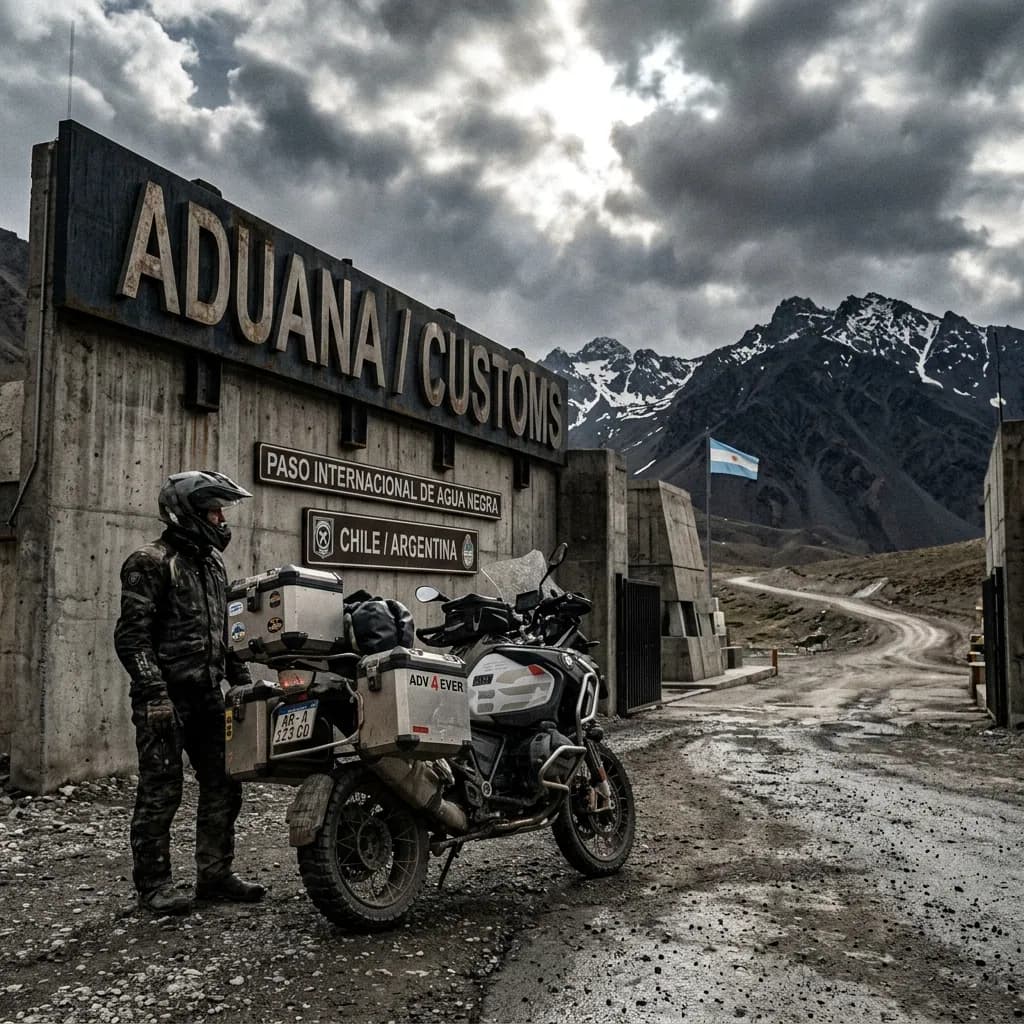
South Africa is the one country in mainland Africa where you can't really avoid a Carnet de Passage en Douane (CPD) to bring in a motorcycle — but only if the bike arrives by air or sea freight. Cross overland instead, from a neighboring country like Namibia, and Customs issues a free Temporary Import Permit (TIP) right at the border post, valid for six months, no carnet needed. It's the classic gateway to routes like Chapman's Peak Drive, the Garden Route and the Swartberg Pass, and the country with the most developed motorcycle-support infrastructure on the continent.
WHAT YOU NEED TO KNOW
The country you're about to enter has particularities you need to know.
Before you cross the border there are four things you need locked down: how safe the country is, what insurance is mandatory for your motorcycle, where you'll actually find fuel, and when to go. None of these are optional.
SAFETY: MODERATE RISK (3/5)
Is South Africa safe to enter by motorcycle? Yes, across most of the country — the real risk concentrates in a handful of well-identified urban spots, not on the routes a motorcycle traveler actually rides.
AREAS TO AVOID
- Johannesburg CBD and Hillbrow: Central Johannesburg has deteriorated markedly over the past two decades and sections of the inner city are effectively controlled by criminal networks, according to the US State Department. Hillbrow specifically is a historically high-crime district — avoid it, especially after dark.
- N2 toward Cape Town International Airport: The stretch of the N2 that skirts Khayelitsha and Nyanga is locally known as the hell run for the frequency of stones thrown from pedestrian bridges and robberies of stopped vehicles. Stay in the fast lane and don't stop for a suspicious obstacle on the road.
- Highway on-ramps and traffic lights in Johannesburg and Pretoria: Johannesburg averages over 5,000 carjackings a year, with highway on-ramps, residential driveways and shopping mall parking areas as the most common hotspots.
- Peripheral townships at night, in any city: Both UK and US authorities agree the most violent crimes concentrate in townships on the outskirts of major cities and in isolated areas — not a typical stop for a motorcycle traveler passing through, but if GPS routes you there at night, get back to the main road.
WHERE TO PARK
- Parking: On the street: fine by day in areas with foot traffic. After dark, look for a gated lot or a backpacker/hotel with security — it's the standard in the main cities.
- Alarm: Recommended: yes, especially in Johannesburg, Pretoria, Durban and central Cape Town. Low priority in rural areas of the Garden Route or the Karoo.
- Luggage: Take off what you can carry (tank bag, backpack, documents) when parking. Never leave anything loose in plain sight inside the panniers.
- Visibility: Park where there's foot traffic and good lighting, near a security camera if possible — never in an alley or dark corner of a city CBD.
TIPS
- ➜Don't ride into Johannesburg or Cape Town at night if you can help it — most vehicle robberies happen between 4pm and 9pm, at highway on-ramps and traffic lights.
- ➜Don't stop for a minor staged collision or fake flat tire in an isolated area — it's a documented robbery tactic in the region; keep going to the next gas station or police post.
- ➜Keep the bike's original papers somewhere other than the panniers or tank bag, in case your luggage gets stolen.
Outside those specific points, South Africa is the country in Africa with the best-developed tourist and motorcycle-travel infrastructure — the risk is real but geographically concentrated, not spread evenly across the whole country the way it can feel from a general crime statistic.
MANDATORY INSURANCE: RAF — Road Accident Fund
Unlike almost every one of its neighbors, South Africa does not require you to buy a specific third-party insurance product at the border. Personal-injury cover for any road user, local or foreign, is funded automatically through a levy built into the fuel price, administered by the state Road Accident Fund. It does not cover damage to the bike or theft, so private insurance for those is worth arranging on your own — especially given the carjacking risk in the cities.
FUEL: GOOD ON MAIN ROUTES
Reliable network of stations selling 93, 95 and 97 octane unleaded plus diesel along the N-roads and major provincial routes, with card payment accepted almost everywhere. Availability drops in remote stretches of the Karoo and the Wild Coast, where towns can be far apart — fill up whenever you pass a station in those areas rather than waiting for the tank to run low.
BEST SEASON: SEP → MAY
September to May overall. Southern spring and summer (September-February) suit the coast and the Garden Route best; the cooler, drier months from May to September work better for the Karoo and the interior, where summer heat gets intense. Winter (June-August) brings cold at altitude and heavy rain in the Cape, though it's also whale-watching season along the coast.
ENTERING SOUTH AFRICA BY MOTORCYCLE
Entering South Africa with a motorcycle splits into two very different paths depending on how the bike gets there. According to Horizons Unlimited's HUBB and other overlander forums, South Africa is the one country in mainland Africa where a Carnet de Passage is, in practice, unavoidable — but strictly for bikes flown or shipped in. Cross by land from a neighboring country instead, and the process is far simpler.
The process has two steps:
Immigration: Stamps your passport on entry and grants your visitor permit, usually 90 days for most nationalities.
Customs: If you're crossing by land, issues the TIP for the motorcycle at the same post. If the bike arrived by air or sea, you present the Carnet de Passage arranged in advance instead.
The TIP (Temporary Import Permit) is free at any land border crossing — SARS doesn't charge anything to issue it, and it's valid for six months.
Real friction point:Motorcycle-travel forums generally agree that South Africa is the one country in mainland Africa where you can't really avoid the Carnet de Passage — but only if the bike arrives by air or sea freight, which is common because South Africa is often the start or finish line of a continental round trip. The Carnet requires a guarantee deposit through your own country's automobile club, calculated on the bike's value and the destination's risk profile; it's not something to leave for the week before you fly.
Since 1 June 2026, add one more step regardless of how you enter: SARS now requires every foreign-registered vehicle to be declared on its TMS (Traveller Management System) both entering and leaving South Africa, even travelers who only need the free TIP.
REQUIRED DOCUMENTATION
Valid passport: Valid for the whole length of your stay. Most nationalities from Europe, the Americas and Oceania get the 90-day visitor permit with no advance paperwork.
Driving license (IDP recommended): Your home country's license is enough if it has a photo, a signature, and is in an official South African language or translated. An International Driving Permit isn't mandatory, but it's easier for traffic police to identify.
Motorcycle title/registration: If you're not the registered owner, you need notarized authorization from them to present at the border post.
TIP or Carnet de Passage en Douane: Free and issued on the spot if you cross by land (TIP). If the bike arrives by air or sea, you need the Carnet arranged before leaving home, through the automobile club in your bike's country of registration.
SARS TMS declaration: Since 1 June 2026, every foreign vehicle must be declared on South African Customs' Traveller Management System both entering and leaving, even with a TIP.
If you're crossing overland from a neighboring country, sorting a foreign motorcycle out at a South African border post is routine: passport stamp, free TIP, and you're riding. The real planning happens earlier, before the trip, only if you're shipping the bike in by air or sea — budget the time and the guarantee deposit for the Carnet de Passage well in advance, because it's not something you can sort out at the last minute at the port.
DAILY BUDGET
This price range combines cheap lodging, cooking your own meals, and basic bike maintenance — the three categories that weigh most on any moto traveler's daily budget.
Your real daily budget is something you build yourself, based on your own needs and limits — but if you want an idea of how to build yours, pick a category to see the full guide:
Full cost breakdown in the budget guide
THE 10 BEST MOTORCYCLE ROUTES IN SOUTH AFRICA
This Top 10 is ordered by real-world fame, not personal taste: it starts with the route any international rider finds first when searching "motorcycle route South Africa" —the one mentioned most often on forums like Horizons Unlimited and ADVrider, on motorcycle travel blogs and in rankings of the world's most spectacular roads— and works its way down to gems that are just as real, but better known regionally among South African riders.
South Africa packs the region's highest mountain border crossing, the continent's most photographed cliffside road and some of the best-preserved gravel passes in the world, hand-built with pick and shovel in the 19th century, into a single country. That's why this Top 10 mixes curvy pavement, technical gravel and the classic end-to-end coastal route — the real combination behind any serious trip through the country.
Several of these routes —starting with Sani Pass— mix technical gravel, altitude and stretches with no services, so it's worth reviewinghow to prepare for a long motorcycle tripbefore heading out, especially if it's your first time far from pavement.
On remote stretches like Prince Alfred's Pass or the climb up Sani Pass itself, there's no repair shop around the corner, so it's worth reviewingthe mechanics guide for long motorcycle tripsbefore heading out.
Sani Pass:South Africa's highest mountain border crossing
Underberg (KwaZulu-Natal) to LesothoClimbing Sani Pass by motorcycle means crossing South Africa's highest mountain border: the summit on the South African side sits at 2,876 meters above sea level, right on the border with Lesotho.
The road began in 1922 as a track barely two meters wide for pack animals; the first jeeps only made it up in 1949, and since 1966 the summit has been the finish line of the historic Roof of Africa Rally, one of Africa's oldest off-road motorcycle competitions.
The last 9km before the border post are pure gravel with gradients up to 1:3 and tight curves along the cliff edge. Wikipedia doesn't soften it: the pass "has claimed many lives," and the remains of vehicles can still occasionally be seen along the road.
On the other side, already in Lesotho, the road keeps climbing toward the Black Mountain Pass, with views over the roof of southern Africa that explain the name of the rally that made it famous.
WARNINGS FOR THIS ROUTE
This is what you need to sort out before riding this route.
- 01Fuel range
Poor. There is no fuel between Underberg and Mokhotlong, already in Lesotho. Head up with a full tank.
- 02Blind hairpins with a history of fatal accidents
Wikipedia documents that the pass "has claimed many lives" and that vehicle remains can still be seen along the road. Take the climb slowly, and don't rush the curves along the drop-off.
Chapman's Peak Drive:Cape Town's cliffside coastal road
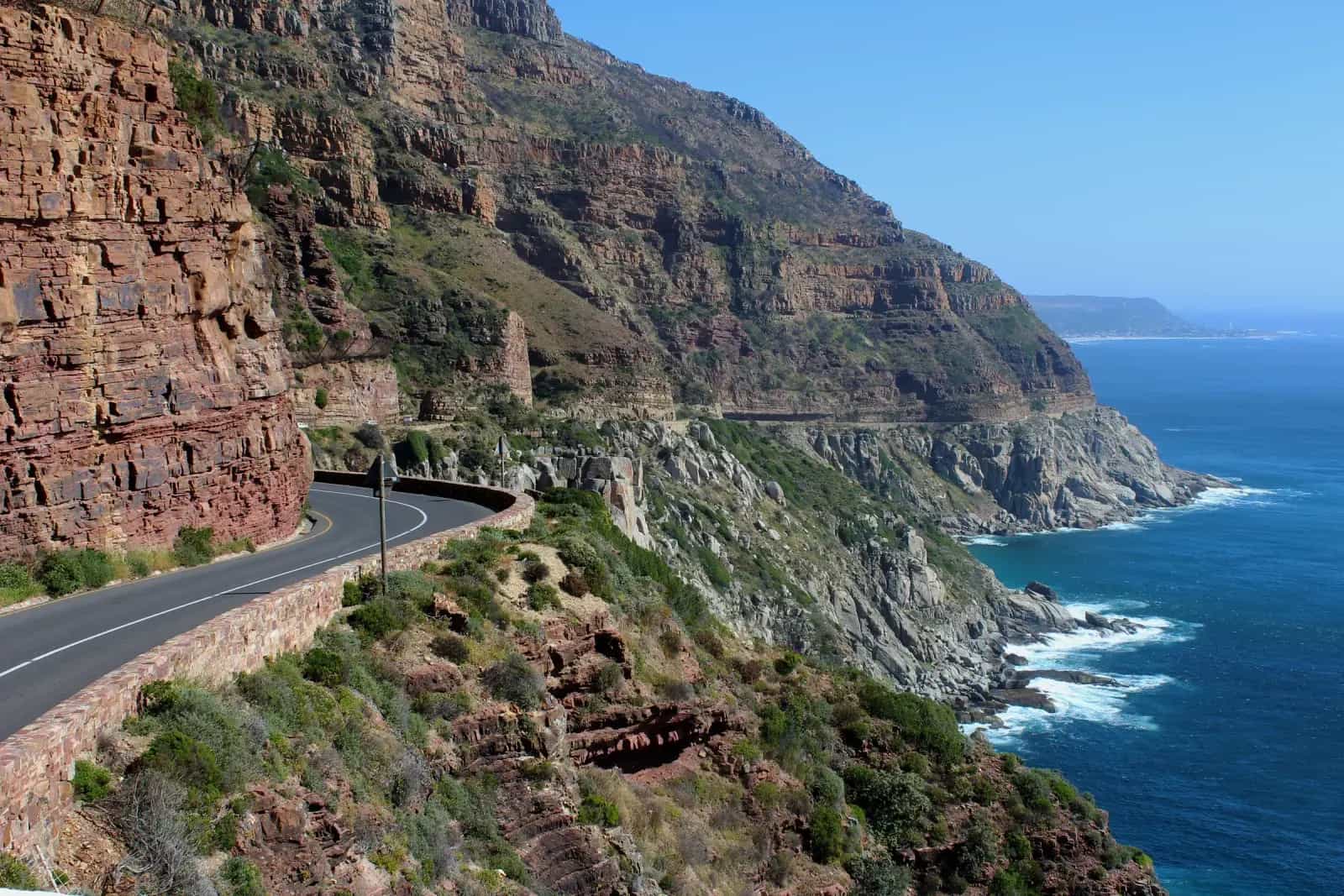
Hout Bay to Noordhoek, Cape TownRiding Chapman's Peak Drive by motorcycle means crossing 9.5km carved straight into the near-vertical face of the mountain, suspended between the Atlantic Ocean and the cliff.
It was built between 1915 and 1922 and officially opened on May 6, 1922: at the time it was considered an unprecedented feat of engineering in southern Africa.
In the 1990s a rockfall caused a death and a lawsuit that kept the road closed for years; it reopened in 2005 as a toll road, and since 2008 it has featured rockfall shelters on the most exposed stretches.
The name comes from John Chapman, a pilot whose ship ran aground in what is now Hout Bay in 1607. Four centuries later, the bend that carries his name is still one of the must-ride postcards for any motorcycle traveler in Cape Town.
WARNINGS FOR THIS ROUTE
This is what you need to sort out before riding this route.
- 01Fuel range
Excellent. There are service stations in Hout Bay and Noordhoek, at both ends of the road.
- 02Documented closures due to rockfalls
The road was closed for several years in the 1990s after a rockfall caused a death, and closed again in 2008 due to newly identified risk zones on the mountain. Check the road's status before heading out, especially after heavy rain.
The Garden Route:South Africa's coastal N2
Witsand to Storms River, Western Cape - Eastern CapeRiding the Garden Route by motorcycle means crossing 300km of South Africa's southeastern coast, between the Indian Ocean and the Langeberg, Outeniqua and Tsitsikamma mountain ranges, passing through Mossel Bay, George, Wilderness, Knysna and Plettenberg Bay.
UNESCO added the area to its World Network of Biosphere Reserves in 2017, and that's no accident: Mossel Bay and Pinnacle Point hold some of the oldest archaeological finds linked to the origins of modern human behavior.
The indigenous Tsitsikamma forest, a mix of Cape fynbos and temperate forest home to nearly 300 bird species, marks the route's natural end at the border with the Eastern Cape.
It's the itinerary every international motorcycle traveler plans first after landing in Cape Town: mild weather 365 days a year, gas stations every few kilometers, and a coastline that never repeats its scenery over 300km.
WARNINGS FOR THIS ROUTE
This is what you need to sort out before riding this route.
- 01Fuel range
Excellent. It's one of the routes with the most service stations in South Africa, with towns every 20-40km.
Swartberg Pass:Thomas Bain's gravel masterpiece
Oudtshoorn to Prince Albert, Western CapeCrossing Swartberg Pass by motorcycle means riding the masterwork of Thomas Bain, the most important road engineer of colonial South Africa, built between 1883 and 1888 using convict labor.
The pass opened on January 10, 1888, and was deliberately never paved: it remains pure gravel, with the same original dry-stone walls still holding up several of its hairpin bends.
It's also the only road access to Gamkaskloof, a valley so isolated its residents lived without roads until the mid-20th century and is still known today as "Die Hel" (the hell, in Afrikaans).
For South Africa's adventure riding community, it's THE reference gravel pass in the country: technical, historic, and without a single strip of pavement across its 24km.
WARNINGS FOR THIS ROUTE
This is what you need to sort out before riding this route.
- 01Fuel range
Fair. There are stations in Oudtshoorn and Prince Albert, at both ends; nothing in between.
- 02Treacherous after rain
Park management itself warns the pass "can be a little treacherous after rain" — loose gravel over wet rock cuts traction hard on the hairpins. Avoid climbing right after a storm.
The Panorama Route:Blyde River Canyon and God's Window
Graskop, MpumalangaRiding the Panorama Route by motorcycle means looking straight into the Blyde River Canyon (now officially renamed the Motlatse), the world's third largest canyon behind the Grand Canyon and the Fish River Canyon, 26km long with subtropical vegetation lining its walls, unlike its two more arid rivals.
The God's Window viewpoint drops the view 700 meters straight down over the forest of the Drakensberg escarpment, one of the most-cited visual drops in the whole country.
At Bourke's Luck Potholes, where the Treur and Blyde rivers meet, centuries of erosion carved perfectly cylindrical pools into the rock; a little further on, the Three Rondavels mimic the shape of traditional African huts in stone.
Along with the nearby Kruger, it's the most photographed area of Mpumalanga and an almost mandatory stop for any motorcycle traveler crossing the northeast of South Africa.
WARNINGS FOR THIS ROUTE
This is what you need to sort out before riding this route.
- 01Fuel range
Excellent. There are stations in Graskop, Hazyview and Pilgrim's Rest, all along the same loop.
Long Tom Pass:the curves between Sabie and Lydenburg
Sabie to Lydenburg (Mashishing), MpumalangaClimbing Long Tom Pass by motorcycle means riding 56km of curves up the Great Drakensberg Escarpment to 2,150 meters above sea level, the highest point on the entire Panorama Route.
The name comes from the "Long Tom" cannons —155mm Creusot guns— fired for the last time in this area by Boer forces during the Second Anglo-Boer War; a monument beside the road marks that final stand.
It's one of the favorite routes for South African motorcycle clubs riding out of Johannesburg or Pretoria toward Kruger: curve after curve of good pavement, through the heart of one of the country's largest planted forests.
The real enemy here isn't the terrain but the weather: thick fog over the escarpment is common enough to cut visibility to just a few meters with any sudden change in conditions.
WARNINGS FOR THIS ROUTE
This is what you need to sort out before riding this route.
- 01Fuel range
Good. There are full-service stations in Sabie and Lydenburg, at both ends of the pass.
- 02Thick fog and low visibility
The pass is prone to heavy mist and can be dangerous in low visibility conditions, according to geographic sources for the area. Slow down and turn on your lights as soon as visibility starts to drop.
Route 62:the world's longest wine route
Ashton to Humansdorp, Western Cape - Eastern CapeRiding Route 62 by motorcycle means covering 504km between Ashton and Humansdorp through the heart of the Klein Karoo, the curvier, slower alternative to the coastal N2 highway.
The route crosses the Langeberg range through the historic Cogmanskloof Pass and runs through towns like Montagu, Barrydale, Ladismith, Calitzdorp and Oudtshoorn, each with its own winery or distillery along the main street.
It's promoted as one of the longest wine routes in the world, with vineyards dating back to the arrival of the first Dutch settlers in the Robertson valley in the 17th century.
It's the favorite route for riders looking for more valley scenery and less highway: gentle curves, dry Klein Karoo temperatures, and a town with a gas station and something to eat every few kilometers.
WARNINGS FOR THIS ROUTE
This is what you need to sort out before riding this route.
- 01Fuel range
Excellent. It's the route with the most fuel-stocked towns along the whole way, every 30-50km.
Bain's Kloof Pass:Andrew Geddes Bain's first road
Wellington to Ceres, Western CapeCrossing Bain's Kloof Pass by motorcycle means riding the first great mountain road built by Andrew Geddes Bain, the father of South African road engineering, constructed with convict labor and opened in 1854.
The road follows the Witte River through a narrow gorge between Wellington and Ceres, with rapids, waterfalls and natural pools visible right from the bike.
Declared a national monument for its historic value, the road was closed for restoration work between 2018 and 2022, and today it's fully paved and open to traffic again.
It's the classic weekend ride for Cape Town motorcycle clubs: close to the city, technical without being extreme, and running through the same gorge that impressed 19th-century travelers.
WARNINGS FOR THIS ROUTE
This is what you need to sort out before riding this route.
- 01Fuel range
Good. There are stations in Wellington and Ceres, at both ends of the road.
Prince Alfred's Pass:South Africa's longest public mountain pass
Knysna to Uniondale, Western CapeRiding Prince Alfred's Pass by motorcycle means covering 68km of mountain gravel, considered the longest publicly accessible pass in all of South Africa.
It was built by Thomas Bain along with 270 convict laborers between 1861 and 1867, connecting the dry interior of the Klein Karoo with the forested Knysna coast through the Outeniqua Mountains — considered one of his finest engineering achievements.
It's named after Prince Alfred, Queen Victoria's fourth child and the first member of the British royal family to visit South Africa, in 1860.
Today it's a classic among South African adventure riders and mountain bikers —the pass is also the backbone of a 100km mountain bike race— but it remains virtually unknown to international motorcycle travelers just arriving in the country.
WARNINGS FOR THIS ROUTE
This is what you need to sort out before riding this route.
- 01Fuel range
Poor. There are no stations along the 68km stretch; fill up in Knysna or Uniondale before setting out.
Clarence Drive:riding False Bay's coastline
Gordon's Bay to Betty's Bay, Western CapeRiding Clarence Drive by motorcycle means following 22km of tight curves carved into the mountainside, with False Bay pounding the rocks just meters from the pavement.
It was built by Italian prisoners of war starting in 1940, during World War II, following the original proposal of businessman Gerald "Jack" Clarence, who gave the road its name.
On clear days, the view takes in the whole of False Bay, Table Mountain in the distance and the entire line of the Cape Peninsula — a postcard that rivals Chapman's Peak Drive on the other side of the peninsula.
Between June and November, much of the route doubles as a southern right whale lookout, as the whales come close to shore to raise their calves right off the same road.
WARNINGS FOR THIS ROUTE
This is what you need to sort out before riding this route.
- 01Fuel range
Good. There are stations in Gordon's Bay at the start and in Betty's Bay/Kleinmond at the end of the ride.
- 02Occasional rockslides
The road has a history of occasional rockslides onto the roadway, especially after winter storms. Slow down if you see loose rock or dirt on the pavement.
NEIGHBORING COUNTRIES
Crossing the border next? Click a country to see its 10 best motorcycle routes.
FREQUENTLY ASKED QUESTIONS
01Do I need a Carnet de Passage to enter South Africa with my motorcycle?
+
Do I need a Carnet de Passage to enter South Africa with my motorcycle?
It depends on how the bike arrives. If you cross a land border (from Namibia, for example), Customs issues a free TIP (Temporary Import Permit) right at the post and no carnet is needed. If the bike arrives by air or sea freight, you do need a Carnet de Passage en Douane arranged before leaving your home country — motorcycle travel forums generally agree it is the one country in mainland Africa where you can't really avoid it.
02What is the TIP and how much does it cost at the border?
+
What is the TIP and how much does it cost at the border?
It's the Temporary Import Permit that the South African Revenue Service (SARS) issues for any foreign-plated vehicle entering by land. It's free, processed at the border post itself, and valid for six months, with multiple re-entries allowed while it's valid. Since 1 June 2026, you also have to declare the vehicle on SARS's TMS (Traveller Management System) both entering and leaving.
03Is it mandatory to buy insurance to enter South Africa by motorcycle?
+
Is it mandatory to buy insurance to enter South Africa by motorcycle?
There is no compulsory third-party liability insurance you have to buy, unlike almost all of its neighbors. South Africa funds the Road Accident Fund (RAF) through a levy built into the fuel price, which covers personal injury for any road user, local or foreign, in the event of a crash. It doesn't cover damage to the bike or theft, so it's worth arranging your own private cover for that part.
04Do I need an International Driving Permit (IDP) to ride a motorcycle in South Africa?
+
Do I need an International Driving Permit (IDP) to ride a motorcycle in South Africa?
It's not legally required if your home license has a photo, a signature, and is in an official South African language or translated, but the local Motorcycle Safety Institute recommends carrying one anyway because an IDP is easier for traffic police to identify at a roadside checkpoint.
05Is it safe to ride at night in South Africa?
+
Is it safe to ride at night in South Africa?
It's not recommended, and not only because of crime. At night you also get loose livestock crossing the road, unmarked potholes and erratic drivers, on top of the fact that vehicle-theft hotspots (highway on-ramps, urban traffic lights) are most active between 4pm and 9pm according to local reports. The advice that comes up again and again among motorcycle travelers and in official guides is to arrive at your destination before dark.
06What's the best time of year to ride through South Africa?
+
What's the best time of year to ride through South Africa?
September through May in general. Southern spring and summer (September to February) are ideal for the coast and the Garden Route; the cooler, drier months (May to September) work better for the Karoo and the interior, where summer heat can be intense. Winter brings heavy rain and cold at altitude in mountain areas like the Drakensberg.
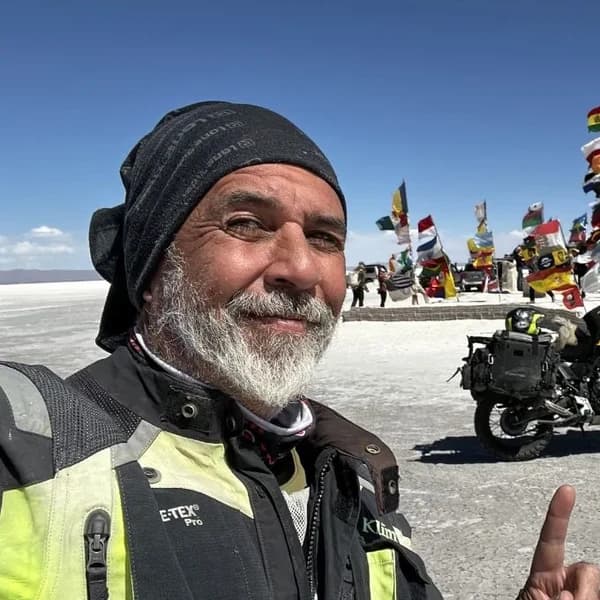
Gustavo Correa
Moto traveler, author and motorcycle travel consultant. 110,000+ km across 4 continents with Gloria, my motorcycle. Everything you read here has been tested on the road, not in an office.
Read my story →Last verified: 2026-08-29
Sources consulted (21)+
- madornomad.com
- aa.co.za
- cpdcarnet.com
- horizonsunlimited.com
- horizonsunlimited.com
- sars.gov.za
- sars.gov.za
- raf.co.za
- en.wikipedia.org
- travel.state.gov
- gov.uk
- iol.co.za
- businesstech.co.za
- msi.org.za
- ekurhuleni.gov.za
- tracks4africa.co.za
- en.wikipedia.org
- wisemove.co.za
- championtraveler.com
- africanoverlandtours.com
- commons.wikimedia.org
A GIFT FOR BEING HERETHE ADVENTURE OF LIVING FREE
Do fear or doubt paralyze you before starting any project? You're not alone — every one of us has been there.
As a thank-you for visiting my site, I'm giving you my book "The Adventure of Living Free". A manual built to bring some light through the shadows and show you the philosophy that has let me ride the world for years.
* PDF STRAIGHT TO YOUR INBOX. NO SPAM.