MOTORCYCLE TRAVEL IN Australia
QUICK ANSWER
Australia has no land borders: bringing your own motorcycle in means shipping it by sea or air to an Australian port (Sydney, Melbourne, Brisbane, Fremantle or Darwin) and clearing it with the Australian Border Force using a valid Carnet de Passage. The real obstacle isn't customs paperwork — it's biosecurity: the Department of Agriculture requires the bike to be showroom-clean, with no mud, insects or organic matter, or it goes into quarantine for up to 14 days. Once inside, you need CTP (the mandatory third-party insurance), which works differently depending on the state.
WHAT YOU NEED TO KNOW
The country you're about to enter has particularities you need to know.
Before you cross the border there are four things you need locked down: how safe the country is, what insurance is mandatory for your motorcycle, where you'll actually find fuel, and when to go. None of these are optional.
SAFETY: VERY LOW RISK (1/5)
Is Australia safe to enter by motorcycle? Yes — it's one of the safest countries in the world to travel through, carrying the same lowest advisory level (Level 1) the US State Department gives it. The real risk for a motorcycle traveler isn't crime — it's wildlife, heat and distance.
AREAS TO AVOID
- Kings Cross (Sydney) at night: The historic nightlife district, with alcohol-fueled violence and documented drink-spiking cases. Traveler safety guides recommend avoiding it after 9pm or, if you go, staying alert and not leaving the bike parked on the street overnight.
- Alice Springs town centre at night: Northern Territory Police statistics show a high number of alcohol-related assaults in Alice Springs — 68 cases in June 2026, out of 126 total assaults recorded that month. If you're riding the Red Centre route, it's worth reaching your accommodation before nightfall instead of wandering downtown at night.
WHERE TO PARK
- Parking: Street parking is fine by day almost everywhere. At night in Sydney and Melbourne, look for a gated or well-lit lot; in outback towns, any lit motel or roadhouse works.
- Alarm: Not essential in most of the country — motorcycle theft isn't a widespread problem. Consider one only if you're leaving the bike for several days in a big-city centre.
- Luggage: Take off soft panniers and any loose gear in plain sight when parking in a city. Less critical on remote outback routes, but still a good habit.
- Visibility: Park where there's foot traffic and good lighting — avoid alleys and the edges of nightlife districts like Kings Cross.
TIPS
- ➜Don't ride at dawn or dusk on rural roads — that's when kangaroos cross the most, and wildlife collisions are the most-cited cause of accidents among motorcycle travelers in Australia.
- ➜Avoid riding at night on long inland highways: road trains (trucks up to 50 meters long) and wildlife show up late and poorly under low beams.
- ➜Carry a satellite communicator or personal locator beacon (PLB) on stretches like the Gibb River Road or the Nullarbor — cell coverage is patchy or nonexistent for hundreds of kilometers.
Outside those specific spots, Australia is one of the calmest countries on the planet to ride through — the real challenge is outback logistics, not urban safety.
MANDATORY INSURANCE: CTP (Compulsory Third Party)
Mandatory in all 8 states and territories, but with no single scheme: in Queensland, Tasmania, Victoria, Western Australia and the Northern Territory it's bundled with registration; in the Australian Capital Territory, New South Wales and South Australia it's bought separately. For a foreign-plated bike each state has its own process — the Northern Territory, for instance, lets you apply for visiting-vehicle cover using the carnet as supporting documentation, while Victoria requires TAC Non-registered Vehicle cover, arranged through VicRoads.
FUEL: SCARCE IN THE OUTBACK
Excellent along the coast and on the highways between capital cities. Inland — Gibb River Road, Nullarbor, Tanami, Gunbarrel — stretches with no station can run over 200 km and a liter can cost more than AUD 2 at remote pumps. On the Gibb River Road, for example, reliable fuel is only found at El Questro (a 17 km detour), Mount Barnett and Drysdale River Station (a 60 km detour) — call ahead to confirm stock and carry extra jerry cans.
BEST SEASON: APR - OCT
April to October for a coast-to-coast crossing: it avoids the rainy, cyclone-prone season in the tropical north (November to April, when Kakadu, the Top End and much of the Gibb River Road flood) and the extreme inland heat of the southern summer (December to February, with regular readings above 45°C/113°F in the outback). The south — Great Ocean Road, Tasmania — is best enjoyed in spring (September-November) and autumn (March-May), with less heat and fewer tourists than the December-January summer.
ENTERING AUSTRALIA BY MOTORCYCLE
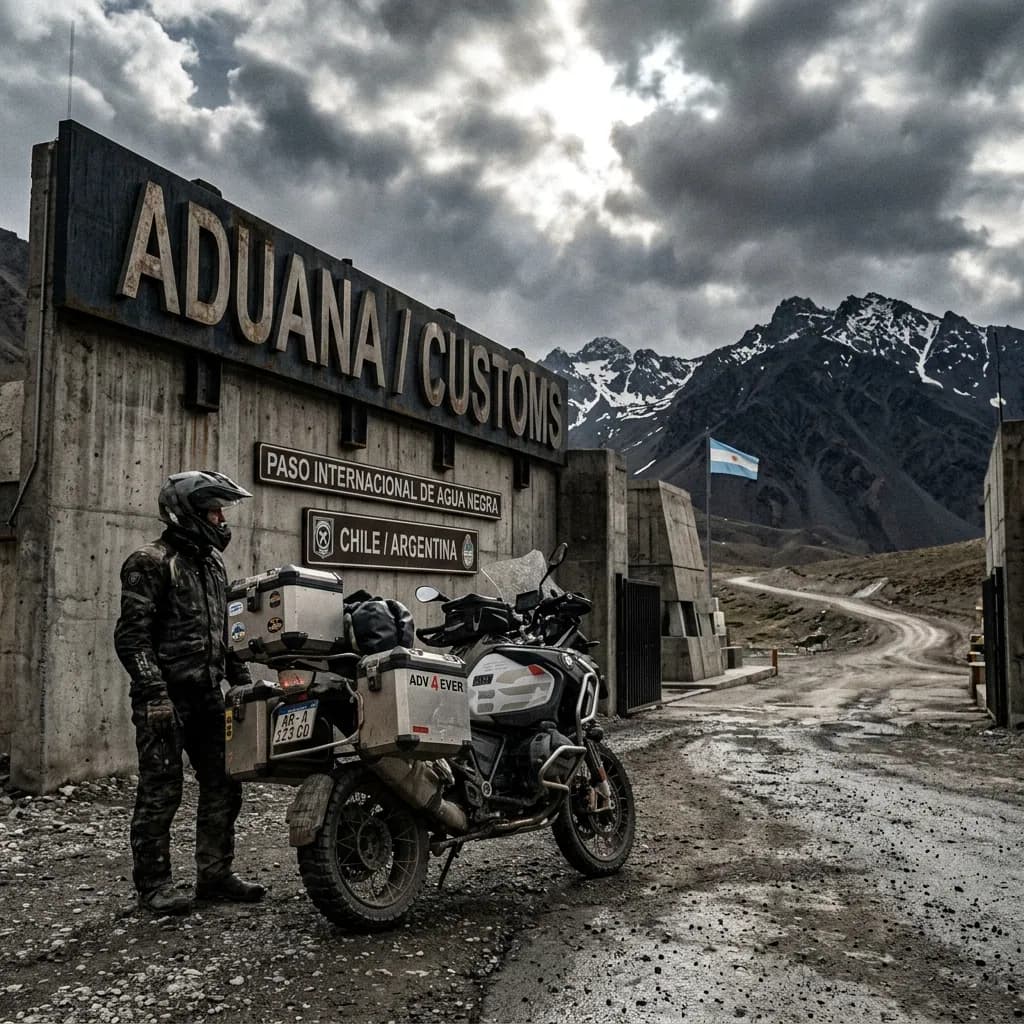
Unlike almost every other country in this guide, entering Australia by motorcycle isn't a land border crossing — it's shipping the bike by sea or air to an Australian port, because Australia is an island continent with no land neighbors.
According to traveler accounts on Horizons Unlimited and the specialized guide Mad or Nomad, the real process has three steps, and the one that decides whether you get through cleanly isn't customs — it's biosecurity:
Shipping the bike: You book a freight forwarder to ship it by sea (RoRo or in a crate) to a port like Sydney, Melbourne, Brisbane, Fremantle or Darwin.
Customs (Australian Border Force): Checks the Carnet de Passage en Douane against the bike. Without a carnet, you need a Vehicle Import Approval (VIA) processed before shipping.
Biosecurity (Department of Agriculture): Inspects the bike for mud, insects or organic matter, with swab tests in hard-to-reach spots. If it fails, the bike goes into quarantine.
Stamping the Carnet de Passage at customs is free — as long as the carnet is valid, you don't pay the import duty (roughly 5% plus GST) or need to process a Vehicle Import Approval.
Real friction point:it isn't customs, it's biosecurity. The Department of Agriculture requires the bike to be showroom-clean — no mud, insects or organic matter anywhere, including the chain, mudguards and airbox — and uses swab tests to check hard-to-reach corners. If it fails, the bike sits in quarantine for up to 14 days and the owner pays for professional cleaning (AUD 200-500 depending on bike size) plus daily storage, according to documented accounts from riders who went through it.
The second friction point is insurance: unlike South America's SOAT or Green Card, Australia has no single CTP valid nationwide — each state administers it differently, and finding coverage that works for a coast-to-coast crossing is a recurring problem among foreign riders, judging by the threads on Horizons Unlimited asking exactly that.
REQUIRED DOCUMENTATION
Passport: Valid for the whole length of your stay.
Carnet de Passage en Douane (CPD): Valid for the whole stay. Can be extended before expiry by filing Form B257 with the Australian Automobile Association.
Motorcycle title/registration: If you're not the owner, you need notarized authorization from them.
Driving license + IDP: Your home license is valid to ride; if it isn't in English, you need an International Driving Permit or an official translation.
CTP (Compulsory Third Party insurance): Arranged according to the state you enter through — the Northern Territory, for example, lets you apply for visitor vehicle cover using the carnet as supporting documentation.
Photo record of the biosecurity clean: Dated photos of the clean bike before shipping — recommended to speed up the inspection on arrival.
With a valid carnet, a spotless bike and CTP for your entry state sorted out, the process itself is routine — the real work happens before the bike goes on the ship, not at the customs counter.
DAILY BUDGET
This price range combines cheap lodging, cooking your own meals, and basic bike maintenance — the three categories that weigh most on any moto traveler's daily budget.
Your real daily budget is something you build yourself, based on your own needs and limits — but if you want an idea of how to build yours, pick a category to see the full guide:
Full cost breakdown in the budget guide
THE 10 BEST MOTORCYCLE ROUTES IN AUSTRALIA
This Top 10 is ordered by real fame, not personal preference: position 1 is the route any international motorcycle traveler finds first when searching "motorcycle route Australia", the one mentioned most on forums like Horizons Unlimited and ADVrider, in ride-report blogs, and in the "best motorcycle roads" lists Australia's own specialist magazines publish. From there, the recognition drops, but every route below still counts as one a foreign rider could name before ever landing in the country.
Australia blends two worlds that rarely coexist in one country: perfectly paved, corner-carving roads like the Great Ocean Road or the Oxley Highway, and remote dirt tracks like the Gibb River Road or the Old Telegraph Track, where the weather decides whether the route is even open. That's why every card leads with the real terrain split (%paved - %unpaved) before anything else: setting off without knowing what kind of bike you actually need is the first mistake that ruins an outback trip.
Before putting the bike on a plane or renting one there, it's worth having the whole trip's logistics sorted out. You can checkhow to prepare for a long motorcycle tripso you don't end up improvising in a country where towns sit hundreds of kilometers apart.
On tracks like the Gibb River Road or the Old Telegraph Track there's no repair shop around the corner, so before heading out it's worth reviewingthe mechanics guide for long motorcycle trips, because any minor breakdown turns into a serious problem 200km from the next town.
The same trip can swing from 45°C on the Nullarbor to near-freezing temperatures at the top of the Great Alpine Road, so having the right gear is no small detail. Checkthe gear guide for long motorcycle tripsbefore you pack.
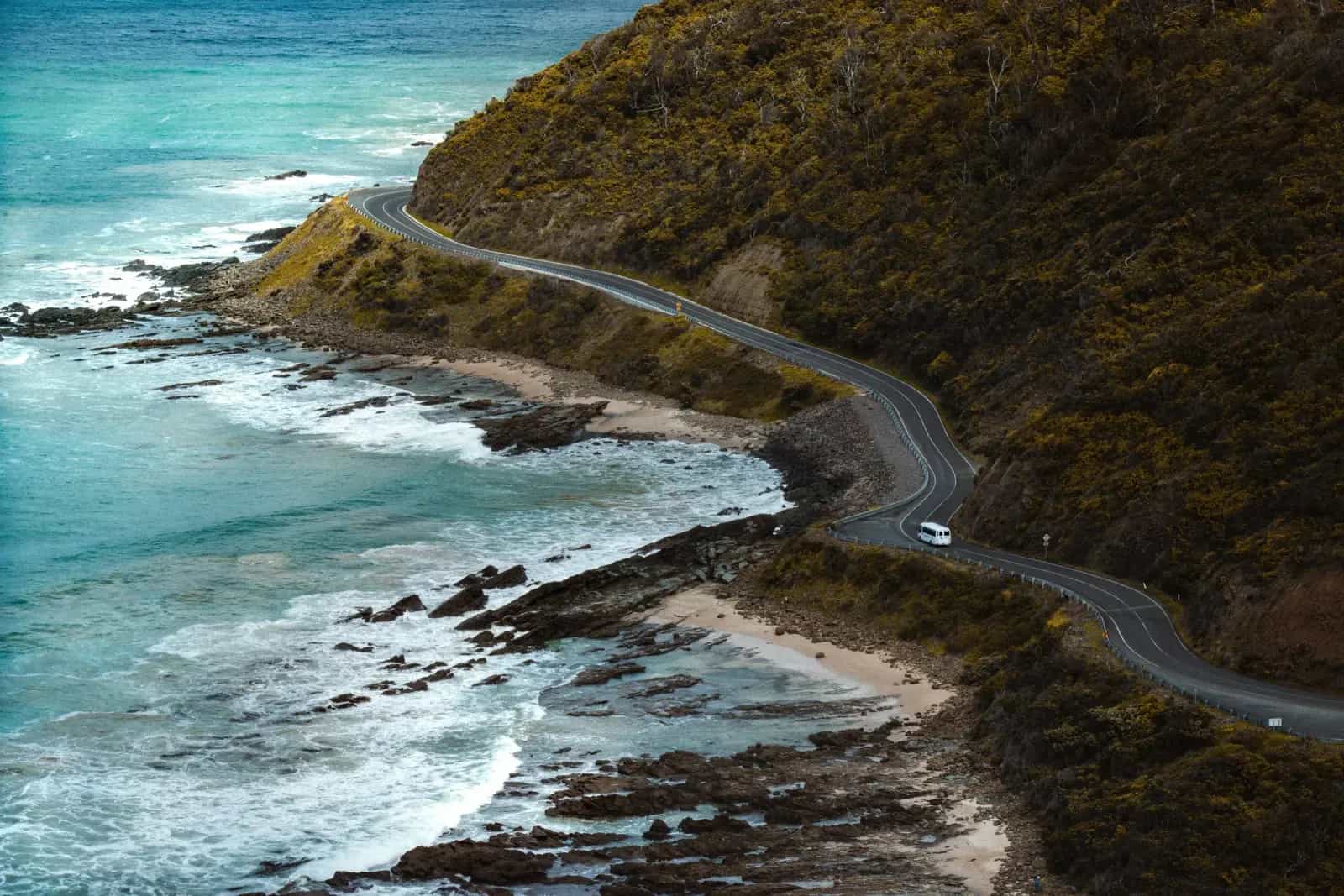
Great Ocean Road:the Twelve Apostles Coastline
VictoriaRiding the Great Ocean Road by motorcycle means crossing the largest war memorial on Earth: the 243km between Torquay and Allansford were carved out by pick and shovel, between 1919 and 1932, by Australian soldiers returning from World War I, as a tribute to their own fallen comrades.
The road hugs the Bass Strait coastline almost without a break, with corners that never repeat themselves twice, all the way to the Twelve Apostles: limestone stacks the sea has been carving for somewhere between 10 and 20 million years, and today there are really only eight left standing, since the surf keeps knocking one down every so often.
It's probably Australia's most photographed road — and also its most car-choked with tourists, so the reward of riding it on two wheels is getting every corner to yourself instead of stuck behind a campervan.
WARNINGS FOR THIS ROUTE
This is what you need to sort out before riding this route.
- 01Fuel range
Excellent. Stations in every coastal town (Torquay, Lorne, Apollo Bay, Port Campbell); never more than 40-50 km without a pump.
Gibb River Road:the Great Kimberley Traverse
Kimberley, Western AustraliaRiding the Gibb River Road by motorcycle means crossing the heart of the Kimberley on a road that was built for cattle, not tourists: the Australian government built it between 1949 and 1956 under the "Beef Roads Scheme," to move livestock from remote stations out to the port of Derby.
It's 660km of corrugated gravel, river crossings and red dust between Derby and Lake Argyle, with mandatory detours to gorges like Windjana Gorge and Tunnel Creek, where water has been carving through limestone for millions of years.
It shuts down completely during the monsoon (November to April): the real riding season lasts barely six months, and that's exactly what keeps it wild — no pavement to make it predictable.
WARNINGS FOR THIS ROUTE
This is what you need to sort out before riding this route.
- 01Fuel range
Critical. Stations only at Imintji, Mount Barnett and Drysdale River Station, more than 100-200 km apart; fuel can cost double what it does on the coast.
- 02Crocodiles at river crossings
Riders who've crossed the route report that, when rivers are running high, you need to watch for crocodiles at the fords — the real advice from those who've done it is never wade in to scout the crossing without checking first.
Oxley Highway:New South Wales' 300 Corners
New South WalesAsk ten Australian motorcyclists their favorite road in the country and at least half will answer without hesitating: the Oxley Highway by motorcycle. It's about 170km between Wauchope and Walcha, with more than 300 corners counted one by one by the local riders themselves.
The road climbs from the Port Macquarie coast up to the New England tablelands over Mount Seaview, and it does it on near-perfect pavement with almost no heavy traffic — a rare thing in any country.
It's not an adventure or outback route: it's pure riding technique, with decreasing-radius corners that, as the regulars themselves admit, still catch out even someone riding it for the hundredth time.
WARNINGS FOR THIS ROUTE
This is what you need to sort out before riding this route.
- 01Fuel range
Good. Stations in Wauchope and Walcha; the only stop mid-mountain is the Gingers Creek café (closed Tuesdays), with no fuel.
Old Telegraph Track:the Far North of Cape York
Cape York, QueenslandFinishing the Old Telegraph Track by motorcycle means literally reaching the northernmost tip of mainland Australia: it's barely 150km from Bramwell Junction, but it's the country's most feared and most searched-for off-road stretch.
The original track dates back to the 1880s, when it was cut to maintain the telegraph line connecting Cairns to Thursday Island. Today that history is little more than trivia next to the crossings that made it go viral: Gunshot Creek, with near-vertical banks that show up in any YouTube search as bikes flying through the air; Palm Creek, with steep entries and exits; and the Dulhunty River, equal parts mud and deep water.
Finishing the whole OTT, without dodging a single crossing on the easier bypass tracks, is one of the few rider achievements that speaks for itself at any gathering of overlanders.
WARNINGS FOR THIS ROUTE
This is what you need to sort out before riding this route.
- 01Fuel range
Very limited. There are no stations along the track itself; fill the tank completely at Bramwell Junction or Bamaga and carry extra reserve.
- 02Gunshot Creek and its vertical banks
It's the crossing that produces the most flipped bikes and rescues on the entire track, documented in dozens of rider videos of people attempting it.
Crossing the Nullarbor:the Eyre Highway End to End
South Australia and Western AustraliaCrossing the Nullarbor by motorcycle means riding across the largest continuous limestone surface on Earth: 1,200km from Norseman to Ceduna over a plain that, according to recent geology, dried out completely somewhere between 2.4 and 2.7 million years ago.
The name comes from the Latin "nullus arbor" — no trees — and it's not an exaggeration: right in the middle sits the 90 Mile Straight, 146.6km without a single bend, the longest straight stretch of road in the country. Running alongside it is the Trans-Australian Railway, which holds the record for the longest straight stretch of track on the entire planet: 478km without deviating a single degree.
The current road, the Eyre Highway, wasn't fully sealed until 1976 — before that, crossing the Nullarbor in any vehicle was a genuine expedition, not a weekend trip.
WARNINGS FOR THIS ROUTE
This is what you need to sort out before riding this route.
- 01Fuel range
Handled by the roadhouses at Balladonia, Caiguna, Cocklebiddy, Madura and Mundrabilla, but some stretches run more than 180km between them — never skip one thinking you'll make the next.
- 02Road trains and wildlife crossing
Road trains on the Eyre Highway can run over 50 meters long and won't be stopping for a motorcycle; on top of that, official warning signs flag camels, wombats and kangaroos crossing, especially at dusk and dawn.
Great Alpine Road:Australia's Sealed Rooftop
VictoriaClimbing the Great Alpine Road by motorcycle up to Mount Hotham means reaching the highest point of any sealed, year-round accessible road in all of Australia: 1,840 meters above sea level, on a 303.7km route between Wangaratta and Bairnsdale.
The road has existed in some form since colonial times, but it was only fully completed between 1997 and 1998, when the final 12km stretch between Dinner Plain and Horsehair Plain was sealed. The name "Great Alpine Road" is even newer: it was only given that name in 1996.
The Bright-to-Hotham section is pure mountain pavement with fast, sweeping curves; the descent toward Omeo, by contrast, turns tight and technical, demanding a lot more attention to your riding.
WARNINGS FOR THIS ROUTE
This is what you need to sort out before riding this route.
- 01Fuel range
Good. Stations in Myrtleford, Bright, Omeo and Bairnsdale; there's no fuel at the top of Hotham.
- 02Mandatory chains during snow season
During the declared snow season, the Harrietville-Omeo section requires mandatory snow chains and can close entirely — check the road's status before heading up in winter.
Great Eastern Drive:Tasmania's East Coast
Tasmania's East CoastRiding the Great Eastern Drive by motorcycle means slowing down along Tasmania's east coast: about 220km between Triabunna and St Helens, passing through Freycinet National Park, the oldest in the entire state.
Inside the park sits Wineglass Bay, repeatedly ranked among the world's best beaches, framed by the Hazards, a chain of pink granite peaks visible from the road in several stretches.
Further north, the Bay of Fires got its name from the Aboriginal campfires navigator Tobias Furneaux spotted along the coast in 1773 — a curious coincidence, because today its granite boulders are covered in a bright orange lichen that, at a glance, looks just like fire.
WARNINGS FOR THIS ROUTE
This is what you need to sort out before riding this route.
- 01Fuel range
Good. Stations in Triabunna, Swansea, Bicheno and St Helens, spread out along the whole route.
Birdsville Track:the Old Outback Droving Route
Inland Queensland to South AustraliaThe Birdsville Track by motorcycle follows, almost exactly, the trail drovers cut in the 1860s to move cattle from inland Queensland down to the nearest railhead, at Marree: it's 517km crossing three deserts back to back, the Strzelecki, the Sturt Stony and the Tirari.
It became legendary because of mailman Tom Kruse, who spent decades delivering the mail along this trail in brutal conditions, an achievement captured in the 1954 documentary "The Back of Beyond."
It's one of the driest regions on the entire continent, with under 100mm of rain a year — and in that emptiness, there's exactly one real point of support along the whole route.
WARNINGS FOR THIS ROUTE
This is what you need to sort out before riding this route.
- 01Fuel range
Critical. The only stop in between is the Mungeranie Roadhouse, 313km from Birdsville and 204km from Marree — no room for error between fill-ups.
Oodnadatta Track:the Old Telegraph and Ghost Train Road
Outback South AustraliaThe Oodnadatta Track by motorcycle retraces a path Aboriginal peoples in the area already used as a trading route, long before explorer John McDouall Stuart passed through in 1859: it's 614km between Marla and Marree, deep in the South Australian outback.
That original trail was later followed by the telegraph line and, after that, by the Central Australia Railway — today's legendary "Ghan" train — which was routed there specifically because of the artesian springs running beneath the desert from the Great Artesian Basin. You can still see ruins of the old telegraph repeater stations at places like Coward Springs.
The track's name was only made official around 1980, and today the essential landmark is the Pink Roadhouse in Oodnadatta, painted bubblegum pink in the middle of nowhere.
WARNINGS FOR THIS ROUTE
This is what you need to sort out before riding this route.
- 01Fuel range
Fair to limited. Roadhouses at William Creek and the Pink Roadhouse in Oodnadatta, 100 to 200 km apart — after rain, even those stretches can get cut off.
Putty Road:Sydney's Backyard Twisties
New South Wales (Windsor to Singleton)The Putty Road by motorcycle connects Windsor, on the outskirts of Sydney, with Singleton, in the Hunter Valley, along 168km of narrow, winding road that cuts through Wollemi National Park — the same place where the Wollemi Pine, a species thought extinct for millions of years, was discovered in 1994.
The road's own encyclopedia entry describes it as popular with tourists, motorcyclists and cyclists, and any Sydney rider knows exactly why: it's the closest weekend escape to the city with real corners.
The northern stretch, locally nicknamed "the 10 mile" for its tightest 16km, holds most of the closed-radius corners and is, without question, the part everyone comes for.
WARNINGS FOR THIS ROUTE
This is what you need to sort out before riding this route.
- 01Fuel range
Excellent at both ends (Windsor and Singleton); in the middle, only limited fuel is available at Colo Heights — best to set off with a full tank.
FREQUENTLY ASKED QUESTIONS
01Can you enter Australia by motorcycle across a land border?
+
Can you enter Australia by motorcycle across a land border?
No. Australia is an island continent with no land borders — the only way to bring your own motorcycle in is to ship it by sea or air to an Australian port and clear it with the Australian Border Force.
02Do you need a Carnet de Passage to bring a motorcycle into Australia?
+
Do you need a Carnet de Passage to bring a motorcycle into Australia?
Yes, it's the recommended and most common route for motorcycle travelers: it lets you temporarily import the bike without paying duty or leaving a cash deposit. It lasts 12 months and can be extended before expiry by filing Form B257 with the Australian Automobile Association.
03How strict is the biosecurity inspection for the motorcycle?
+
How strict is the biosecurity inspection for the motorcycle?
Very. The Department of Agriculture requires the bike to be showroom-clean, with no mud, insects or organic matter, and uses swab tests on spots like the chain or the airbox. If it fails, it goes into quarantine for up to 14 days and the owner pays for professional cleaning.
04What insurance do you need to ride legally in Australia?
+
What insurance do you need to ride legally in Australia?
CTP (Compulsory Third Party) insurance, mandatory in all 8 states and territories but with no single national scheme — each state handles it differently, so you sort it out based on the state or port you enter through.
05What's the best time of year to ride across Australia?
+
What's the best time of year to ride across Australia?
April to October for a coast-to-coast crossing, avoiding the cyclone and rainy season in the tropical north (November-April) and the extreme summer heat inland (December-February, over 45°C/113°F in the outback).
06What is the real risk of riding through the Australian outback?
+
What is the real risk of riding through the Australian outback?
It's not crime — it's wildlife, heat and distance. Kangaroos cross the road at dawn and dusk, road trains run up to 50 meters long, and there are stretches of hundreds of kilometers with no cell coverage or fuel stations — carrying water, extra fuel and a satellite communicator isn't optional.
Gustavo Correa
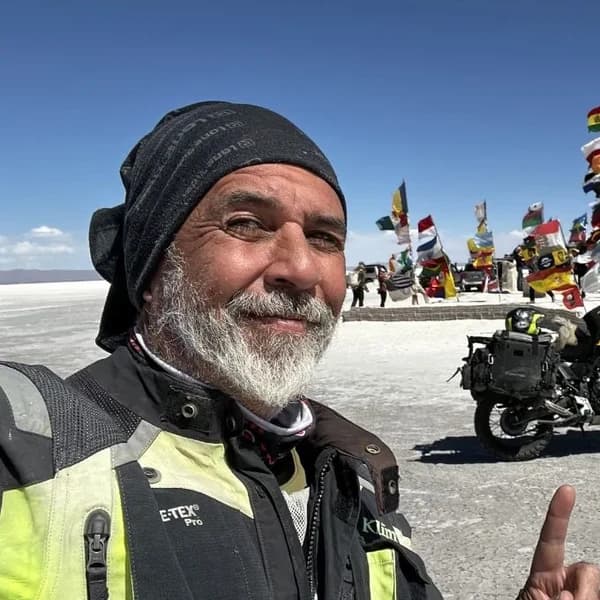
Moto traveler, author and motorcycle travel consultant. 110,000+ km across 4 continents with Gloria, my motorcycle. Everything you read here has been tested on the road, not in an office.
Read my story →Last verified: 2026-08-29
A GIFT FOR BEING HERETHE ADVENTURE OF LIVING FREE
Do fear or doubt paralyze you before starting any project? You're not alone — every one of us has been there.
As a thank-you for visiting my site, I'm giving you my book "The Adventure of Living Free". A manual built to bring some light through the shadows and show you the philosophy that has let me ride the world for years.
* PDF STRAIGHT TO YOUR INBOX. NO SPAM.