MOTORCYCLE TRAVEL IN India
QUICK ANSWER
Riding India by motorcycle doesn't work like crossing a South American country on your own bike: temporarily importing it requires a Carnet de Passage en Douane, an expensive process (a security deposit of 50 to 100% of the bike's value) that almost no independent motorcycle traveler ends up using. The route the vast majority actually takes is different: enter with an e-Tourist Visa and an International Driving Permit, and rent a Royal Enfield once in the country to tackle the high-altitude Himalayan routes — Ladakh, Leh, the Khardung La pass — without the customs paperwork.
WHAT YOU NEED TO KNOW
The country you're about to enter has particularities you need to know.
Before you cross the border there are four things you need locked down: how safe the country is, what insurance is mandatory for your motorcycle, where you'll actually find fuel, and when to go. None of these are optional.
SAFETY: MODERATE RISK (3/5)
Is India safe to enter by motorcycle? Yes, with caveats — the real risk for a motorcycle traveler isn't street crime but the traffic itself (India has one of the highest road fatality rates in the world) and a handful of specific zones with active conflict.
AREAS TO AVOID
- Manipur: The US State Department advises not traveling to the state due to active ethnic conflict, with reports of extensive violence and community displacement.
- Kashmir Valley (Srinagar, Gulmarg, Pahalgam): The same department recommends not traveling to Jammu and Kashmir except for the eastern Ladakh region and its capital, Leh — which are part of the usual motorcycling circuit and considered safe.
- 10 km strip south of the Line of Control with Pakistan: Active military tension zone, outside any real tourist or motorcycling route.
- Remaining pockets of the former "Red Corridor" (Chhattisgarh, Jharkhand, Odisha): The Naxalite insurgency, which affected nearly 180 districts at its peak in the 2000s, was declared eradicated by the Indian government in August 2026, with zero active districts remaining. The practical risk for a motorcycle traveler is now essentially nil, but it's still worth avoiding detours into the rural interior of these states if traveling solo, given the area's recent history.
WHERE TO PARK
- Parking: On the street during the day is fine in busy areas; at night, look for a hotel with gated or watched parking — standard practice at guesthouses along touring routes like Leh or Manali.
- Alarm: Uncommon on rental bikes. If you bring your own motorcycle, a disc or chain lock handles most cases — opportunistic theft is more common than organized theft.
- Luggage: Take off the panniers or bags you can carry when you leave the bike on the street, especially in big cities. Much less necessary in rural Himalayan areas.
- Visibility: Park where there's foot traffic and good lighting; avoid alleys or empty lots, especially in the big cities of the north.
TIPS
- ➜Avoid riding at night on rural or mountain roads: loose animals, trucks with no rear lights, and unmarked potholes are the norm, not the exception.
- ➜Traveling solo as a woman calls for extra precautions — the US State Department itself updated its advisory to recommend against solo travel for women.
- ➜Use your horn the way everyone else does: in India it announces your presence, not aggression — it's part of how the road gets shared.
Outside those specific zones and the traffic chaos itself — which you get the hang of within a couple of days of riding — India is a country the vast majority of motorcycle travelers ride through without serious incidents, and where the hospitality shown toward motorcycle travelers is, according to the accounts of people who've already crossed it, one of the trip's biggest draws.
MANDATORY INSURANCE: Mandatory Third-Party Insurance
Every vehicle on the road in India must have valid third-party liability insurance by law. Coverage from your home country — including any Green Card or equivalent — is not valid on Indian soil: if you rent a Royal Enfield, the agency includes it in the contract by law; if you import your own motorcycle with a Carnet de Passage, you have to take out a local policy while processing entry through customs.
FUEL: SCARCE IN THE HIMALAYAS
Good availability on national highways and in big cities. On the high-altitude routes it changes: between Kaza and Batal, in Spiti, there are 112 km with no station (carry at least 3 liters in reserve); between Tezu and Walong, in Arunachal Pradesh, it is 190 km with no pump; and in Mon district, Nagaland, some stretches run over 120 km without fuel. Fill up every time you pass a town with a station.
BEST SEASON: MAY → SEP (HIMALAYAS)
May to September for the Himalayan circuit (Ladakh, Spiti, Manali-Leh), with September as the month motorcycle travelers themselves recommend most: the passes are already open, the monsoon is retreating, the landscape looks freshly washed, and there are far fewer tourists than in July-August. Avoid the peak of the monsoon (July-August) on stretches outside Ladakh's rain shadow, such as the Manali-Leh highway through Kinnaur, where landslide risk rises. The rest of the country (Rajasthan, Goa, the south) is best ridden October to March, away from the extreme heat and the monsoon itself.
ENTERING INDIA BY MOTORCYCLE
According to traveler accounts on Horizons Unlimited and guides from operators specialized in India expeditions, entering India with your own motorcycle is technically possible but impractical for an independent trip: the country requires a Carnet de Passage en Douane for any foreign-plated vehicle, whether it arrives by ship at a port like Chennai or Mumbai, or overland from Nepal (the Wagah crossing with Pakistan has been closed indefinitely since May 2025).
That's why the vast majority of people riding the Himalayas don't import anything: they fly in with an e-Tourist Visa and rent a Royal Enfield in Delhi, Manali or Leh. In that case, the process has two steps:
Immigration: Stamps your passport based on the e-Visa arranged online before travel.
Customs (only if bringing your own motorcycle): The Carnet de Passage is stamped on entry and exit; the vehicle must be re-exported within 6 months. If you rent a Royal Enfield in the country, this step doesn't exist — the agency handles insurance and registration for you.
Thanks to the Carnet de Passage, the temporary import itself is duty-free — no import tax is paid to Indian customs. What does cost money is the carnet's own security deposit (50-100% of the bike's value), which is refunded when you re-export it.
Real friction point:the Carnet de Passage is not a quick border-crossing formality — you apply for it weeks in advance in your own country (2 to 6 weeks) through your motoring club (AAA, ADAC, RAC, depending on your nationality), it costs between $300 and $600 plus a security deposit of 50 to 100% of the bike's value, and the stay permit is only 6 months — extensions depend on the central government and are rarely granted.
That's why almost nobody uses it for a short trip: between the cost, the processing time, and the fact that your home country's liability insurance isn't valid on Indian soil (you have to take out a local policy), renting a Royal Enfield in the country ends up simpler and cheaper than importing your own bike.
REQUIRED DOCUMENTATION
Passport + e-Tourist Visa: Arranged online before you travel; there are 30-day, 1-year and 5-year versions.
Carnet de Passage en Douane (CPD): Only if you bring your own motorcycle — requested through your home motoring club weeks before travel. Not needed if you rent in the country.
Motorcycle title/registration: Required to process the Carnet; if you're not the registered owner, you need notarized authorization from them.
Driving license + International Driving Permit (IDP): The IDP needs a motorcycle category and must be arranged in your home country — it cannot be issued inside India.
Valid third-party liability insurance in India: Legally mandatory to ride. Your home country's insurance is not valid — if you rent, the agency includes it; if you import, you arrange it while processing the carnet.
Shipping documents (Bill of Lading): Only if the motorcycle arrives by sea at a port like Chennai or Mumbai.
With these documents sorted, entering India by motorcycle is workable under either scenario — bringing your own bike or renting once there — but they're completely different experiences in cost and prep time.
The advice that comes up most among people who've actually made the trip: if you're coming for under two or three months, rent a Royal Enfield in the country. If you're on a multi-year round-the-world trip and the Carnet is already part of your routine, India is just another stage — expensive, but not impossible.
DAILY BUDGET
This price range combines cheap lodging, cooking your own meals, and basic bike maintenance — the three categories that weigh most on any moto traveler's daily budget.
Your real daily budget is something you build yourself, based on your own needs and limits — but if you want an idea of how to build yours, pick a category to see the full guide:
Full cost breakdown in the budget guide
THE 10 BEST MOTORCYCLE ROUTES IN INDIA
The order of this Top 10 is not a personal preference: it follows real-world fame, from highest to lowest. Position 1 is the route that any international motorcycle traveler searching "best motorcycle route India" or "Manali Leh bike trip" finds first — the one cited most often on forums like Horizons Unlimited and ADVrider, repeated most in trip reports, videos and moto-travel blogs, and ridden most by both Indian riders and foreigners who rent a Royal Enfield to cross the Himalayas. From there, the fame drops off gradually, but all ten routes remain genuinely recognized places, never personal discoveries with no real following.
Crossing passes above 5,000 meters demands a bike and a body that are genuinely ready — before heading out on any of these routes, it is worth reviewingthe mechanics guide for long motorcycle trips, because on the Changthang plateau or at Zoji La there is no repair shop around the corner.
Extreme cold, altitude and direct Himalayan sun punish the body as much as the gear, even in the middle of summer.
That is why, before loading up the bike for Ladakh or Spiti, it is worth checkingthe gear guide for long motorcycle trips, covering what you actually need to go from 30 degrees in the valley to below freezing at the pass, in the same day.
Manali-Leh Highway:the most famous ride in India
Himachal Pradesh to LadakhRiding the Manali-Leh Highway by motorcycle is, for any international rider, the trip that defines India: 428 km between Himachal Pradesh and Ladakh that climb above 3,900 meters four separate times.
Construction began in 1964, and only in 1989 did it open as the second land route into Ladakh. Today it crosses the Rohtang La (3,980 m), the Baralacha La (4,850 m), the Lachulung La (5,065 m) and finishes at the Tanglang La, at 5,328 masl, the highest point of the entire route.
Most of the meltwater streams have no bridge: you cross them straight through icy water over a bed of loose stones that shifts every season. It is why almost everyone who rides this highway describes it as the rite of passage for motorcyclists in the Himalayas.
WARNINGS FOR THIS ROUTE
This is what you need to sort out before riding this route.
- 01Fuel range
Critical. After Tandi, near Keylong, there is no official fuel until Upshi, nearly 365 km away. Carrying extra jerry cans is mandatory.
- 02Unbridged water crossings
Many meltwater streams, especially between Baralacha La and Pang, have no bridge: you cross them straight through icy water over loose stone. The flow rises in the afternoon as the glacier melts, so it is best to cross early in the morning.
Srinagar-Leh Highway:the other road to Ladakh
Jammu and Kashmir to LadakhRiding the Srinagar-Leh Highway by motorcycle means following a trade corridor once used by porter caravans carrying pashmina wool in the 17th and 18th centuries, later improved by Dogra rule in the 19th century for pony caravans.
The route climbs Zoji La (3,528 m) and Fotu La (4,108 m, the highest point on the entire highway), and passes through Dras, the second-coldest permanently inhabited place on Earth, with lows of down to -45 degrees Celsius.
The modern road was only built after the 1962 Sino-Indian war and opened to civilian traffic in 1974; today the Border Roads Organisation clears it of snow and landslides every spring before the season starts.
WARNINGS FOR THIS ROUTE
This is what you need to sort out before riding this route.
- 01Fuel range
Good in Srinagar and Kargil, but none along the Zoji La stretch. Fill the tank completely before Sonamarg.
- 02Convoy crossing and sudden closures
Zoji La is crossed via a convoy system run by the Border Roads Organisation, with fixed up and down schedules due to the road's narrow width. An out-of-season snowfall can close it completely even in the middle of summer.
Khardung La and Nubra Valley:the highest pass in Ladakh
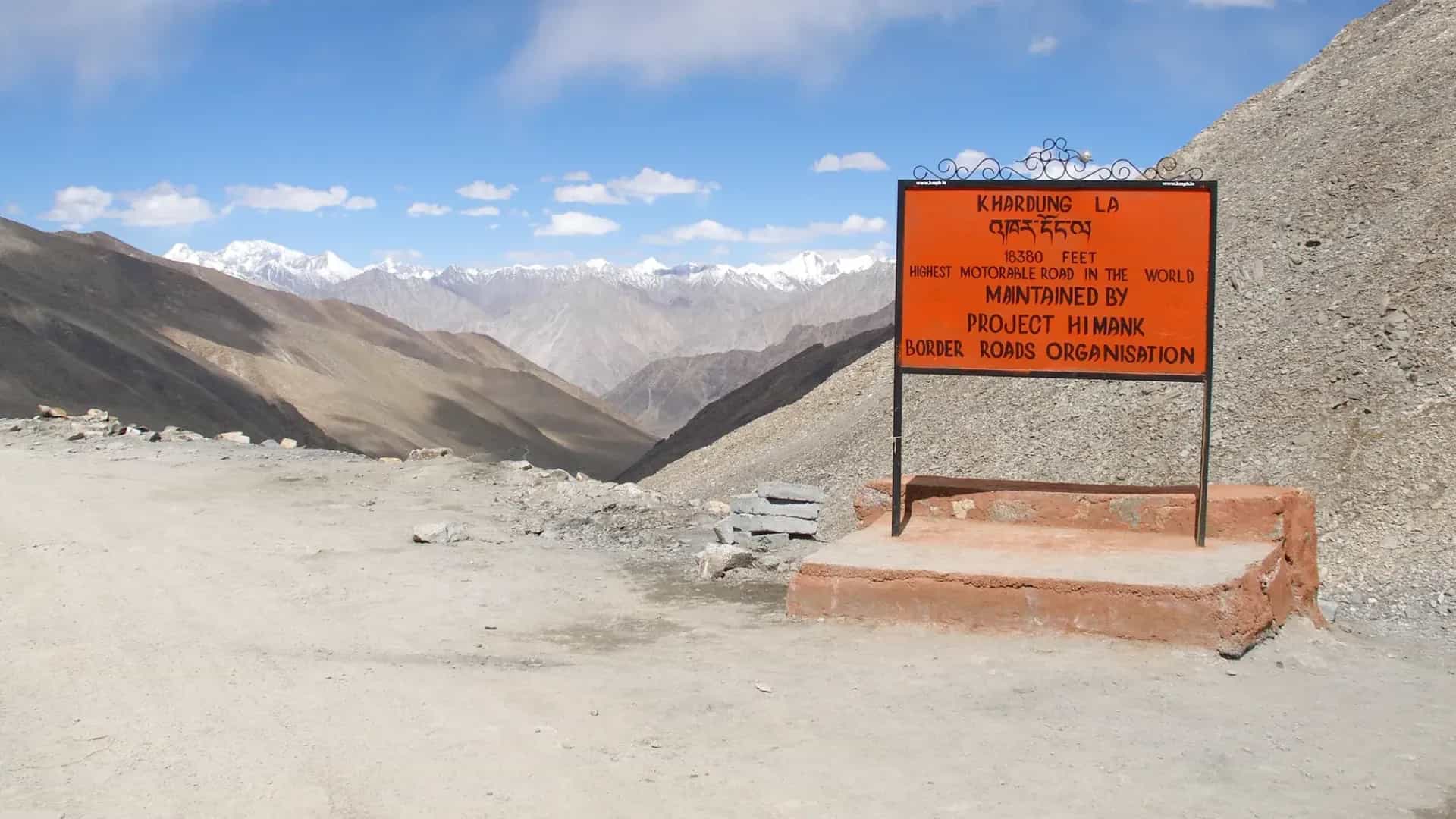
Ladakh (Leh to Nubra)Crossing Khardung La by motorcycle means climbing a strategic road built in 1976 by the Border Roads Organisation to connect Leh with the Nubra Valley. Local signs still claim an altitude of 5,602 meters and the title of third-highest motorable pass in the world, though GPS measurements place the real summit closer to 5,359 masl — either way, it remains one of the highest roads on the planet.
On the other side waits Nubra: a valley averaging over 3,000 meters in altitude, with 7 km of sand dunes between Hundar and Diskit where two-humped Bactrian camels still graze among seabuckthorn shrubs.
In Diskit, a 14th-century monastery watches over the valley from above, crowned by a 32-meter Maitreya Buddha statue. Nubra was for centuries a Silk Road corridor toward Yarkand and Baltistan, closed since 1947 and 1950 respectively.
WARNINGS FOR THIS ROUTE
This is what you need to sort out before riding this route.
- 01Fuel range
Good in Leh and Diskit; there are no stations between the pass and the valley, so leave with a full tank.
- 02Mandatory altitude acclimatization
Since 2022, at least two days of acclimatization in Leh are mandatory before crossing the pass. Acute mountain sickness, brought on by climbing too fast, is the most common cause of medical emergencies on this stretch.
Pangong Tso:the lake that put Ladakh on the map
Ladakh (Leh to Pangong Tso)Reaching Pangong Tso by motorcycle means riding the final kilometers to a lake that stretches 134 km at 4,300 masl, of which barely a third lies on the Indian side: the rest belongs to Chinese-administered territory.
The water changes character depending on the shore: the eastern end has low salinity (0.68 g/L of dissolved solids), while the west is far saltier (11.02 g/L) — and yet the entire lake freezes solid in winter.
Pangong Tso was a near-unknown destination outside Ladakh until the closing scene of the Bollywood film "3 Idiots" (2009) turned it into a global tourist magnet overnight, with a rise in visitors that now demands more infrastructure than the area can comfortably support.
WARNINGS FOR THIS ROUTE
This is what you need to sort out before riding this route.
- 01Fuel range
None near the lake. Fill the tank completely in Karu, the last fuel point before the climb.
Spiti Valley:the cold desert of the Himalayas
Himachal Pradesh (Manali to Kaza via Kunzum La)Crossing Spiti Valley by motorcycle means entering the "middle land" — that is what Spiti means — between Tibet and India, a cold desert running from 2,950 to 4,100 meters in altitude.
The area sits in the rain shadow of the main Himalayan range: it gets just 50 mm of rain a year, with extremes ranging from -25 degrees in winter to 15 degrees in summer. Kunzum La, at 4,590 masl, is the gateway connecting Spiti to Lahaul.
In Tabo, the Buddhist monastery was founded in the year 996, making it one of the oldest continuously functioning monasteries in the entire Himalayas — comparable, some historians say, to the Ajanta caves in artistic and historical value.
WARNINGS FOR THIS ROUTE
This is what you need to sort out before riding this route.
- 01Fuel range
Critical. The last station before Kaza is in Gramphu; there is no official fuel between Losar and Kaza.
- 02Unstable road along the Spiti River
NH-505 follows the Spiti River canyon with steep climbs and sections that wash out after every thaw; it is commonly described as a treacherous road, in worse condition than the alternative route via Shimla.
Umling La:the highest motorable road in the world
Ladakh (Changthang, near Demchok)Climbing to Umling La by motorcycle means reaching 5,799 meters on the Chisumle-Umling La-Demchok road, built in 2017 by the Border Roads Organisation on the remote Changthang plateau, near Demchok, close to the border with China.
Since 2017, Umling La has held the Guinness World Record for the highest motorable road, a title that turned it almost overnight into a bucket-list goal for motorcycle travelers worldwide.
The air up here holds a fraction of the oxygen found at sea level: in 2022, two teams set the world record for highest-altitude auto-rickshaw driving right at this pass, proof of just how far the obsession with it goes.
WARNINGS FOR THIS ROUTE
This is what you need to sort out before riding this route.
- 01Fuel range
Critical. There are no stations anywhere on the Changthang plateau; fill up in Leh and carry an extra jerry can.
- 02Oxygen scarcity at the summit
Above 5,700 masl, the lack of oxygen reduces both engine and rider performance. It is recommended not to stay at the summit for more than 15 to 20 minutes and to avoid any sudden physical exertion.
Ooty Ghat Road:the hairpins of the Nilgiris
Tamil Nadu (Mettupalayam to Ooty)Climbing the Ooty Ghat Road by motorcycle means gaining 2,240 meters of altitude on a road with consecutively numbered hairpin bends, the most repeated postcard image of motorcycling in South India.
The same hillside is climbed by the Nilgiri Mountain Railway, a 46 km rack railway opened in 1908, with a maximum gradient of 1 in 12 — the steepest in Asia — and declared a UNESCO World Heritage Site in 2005 as an extension of the Darjeeling Himalayan Railway.
Ooty began as a British sanitarium in the early 19th century and was made a municipality in 1866: the same colonial officials fleeing the heat of the plains unknowingly laid out one of the most celebrated mountain roads in Indian motorcycling.
WARNINGS FOR THIS ROUTE
This is what you need to sort out before riding this route.
- 01Fuel range
Excellent. Stations in Mettupalayam, Coonoor and Ooty; no fuel-risk stretches.
Goa to Gokarna Coast:the coastal ride through Karnataka
Goa to Karnataka (Arabian Sea coast)Riding the coast from Goa to Gokarna by motorcycle along NH66 means following the corridor that only in the 1960s and 1970s replaced the ships and steamers that had until then been the sole means of transport along India's entire west coast.
The route runs through Maharashtra, Goa, Karnataka, Kerala and Tamil Nadu hugging the Arabian Sea, past coconut palms, paddy fields and arecanut plantations, with narrow, uneven stretches that, far from scaring riders off, are part of the appeal.
The Goa-Gokarna stretch links Goa's touristy northern beaches with Gokarna, a Hindu temple town with much quieter beaches like Om Beach and Kudle Beach, and it is one of the favorite circuits for backpackers riding the west coast without a fixed schedule.
WARNINGS FOR THIS ROUTE
This is what you need to sort out before riding this route.
- 01Fuel range
Excellent. Frequent stations all along NH66; no fuel-risk stretches.
Chopta and Tungnath:the highest Shiva temple in the world
Uttarakhand (Rishikesh to Chopta)Reaching Chopta and Tungnath by motorcycle means riding up to an alpine meadow popularly known as the Mini Switzerland of India, then walking the final 5 km to a temple that, according to legend, was built by the Pandavas after the Kurukshetra war and is believed to be around 1,000 years old.
At 3,680 masl, Tungnath is one of the highest Shiva temples in the world and the highest of the five Panch Kedar temples. Two kilometers further up, at the summit of Chandrashila, at the same elevation, one of the best views in the Himalayas opens up: the peaks of Nanda Devi, Panch Chuli, Bandarpoonch, Kedarnath, Chaukhamba and Neelkanth, all visible at once.
In March, the Chopta meadow fills with blooming rhododendrons, from crimson to pink, over forests that climb straight up to the tree line.
WARNINGS FOR THIS ROUTE
This is what you need to sort out before riding this route.
- 01Fuel range
Good as far as Ukhimath; after that there are no stations until Chopta, so leave with a full tank.
Shillong to Cherrapunji and Dawki:the living root bridges of Meghalaya
Meghalaya (Shillong to Cherrapunji and Dawki)Riding through Shillong, Cherrapunji and Dawki by motorcycle means crossing the wettest region on the planet: Cherrapunji (also called Sohra) holds the Guinness World Records for both highest monthly rainfall, 9,300 mm in July 1861, and highest annual rainfall, 26,461 mm between August 1860 and July 1861.
Along the way, the Khasi people grow living bridges by training the roots of the rubber fig tree (Ficus elastica) across rivers for 10 to 15 years: the oldest one still in use is over 500 years old.
The ride ends in Dawki, on the border with Bangladesh, famous for the exceptional clarity of the Umngot River's waters, often described as one of the cleanest rivers in all of Asia.
WARNINGS FOR THIS ROUTE
This is what you need to sort out before riding this route.
- 01Fuel range
Good in Shillong and Cherrapunji; scarce near Dawki, so do not drop below half a tank.
- 02Landslides outside the dry season
Outside the dry season (October-April), extreme rainfall can trigger landslides on the mountain road between Shillong and Cherrapunji. It is worth checking the route's status before heading out.
NEIGHBORING COUNTRIES
Crossing the border next? Click a country to see its 10 best motorcycle routes.


FREQUENTLY ASKED QUESTIONS
01Can I bring my own motorcycle into India?
+
Can I bring my own motorcycle into India?
Yes, but you need a Carnet de Passage en Douane, arranged through your home motoring club weeks before travel, plus a security deposit of 50 to 100% of the bike's value. Given the cost and the time it takes, most independent motorcycle travelers prefer to rent a bike once they're in the country.
02What is a Carnet de Passage and why does India require it?
+
What is a Carnet de Passage and why does India require it?
It's a customs document that lets you temporarily import a foreign-plated vehicle without paying duties, in exchange for a guarantee that it will leave the country within the deadline — in India, a maximum of 6 months. It works like a passport for the motorcycle, and without it the vehicle can be held at the border.
03Is it better to rent a Royal Enfield than bring my own motorcycle to India?
+
Is it better to rent a Royal Enfield than bring my own motorcycle to India?
For a trip of a few weeks or months, yes, almost always: you skip the cost and paperwork of the Carnet, and the Royal Enfield has by far the widest network of spare parts and mechanics in the country, even in remote Himalayan villages.
04What documents does a rental agency ask a foreigner for?
+
What documents does a rental agency ask a foreigner for?
A passport with a valid visa, your home country driving license, and an International Driving Permit (IDP) with a motorcycle endorsement. The IDP has to be arranged before you travel — it cannot be issued inside India.
05Is it safe to travel through India by motorcycle?
+
Is it safe to travel through India by motorcycle?
Yes, across the vast majority of the country. The real risk for a motorcycle traveler is the traffic itself, not crime: you should specifically avoid Manipur, the Kashmir Valley (except Ladakh and Leh), and the strip near the Line of Control with Pakistan.
06What's the best season to ride a motorcycle through the Indian Himalayas?
+
What's the best season to ride a motorcycle through the Indian Himalayas?
May to September, with September as the month motorcycle travelers themselves recommend most: the mountain passes are already open, the monsoon is retreating, and there are fewer tourists than in July and August.
07Can you cross from Nepal into India by motorcycle?
+
Can you cross from Nepal into India by motorcycle?
Yes, through the Sonauli or Raxaul crossings, but only if your motorcycle has a valid Carnet de Passage. A motorcycle rented in India, with Indian plates, cannot leave the country without that same document — so it won't work for crossing into Nepal.
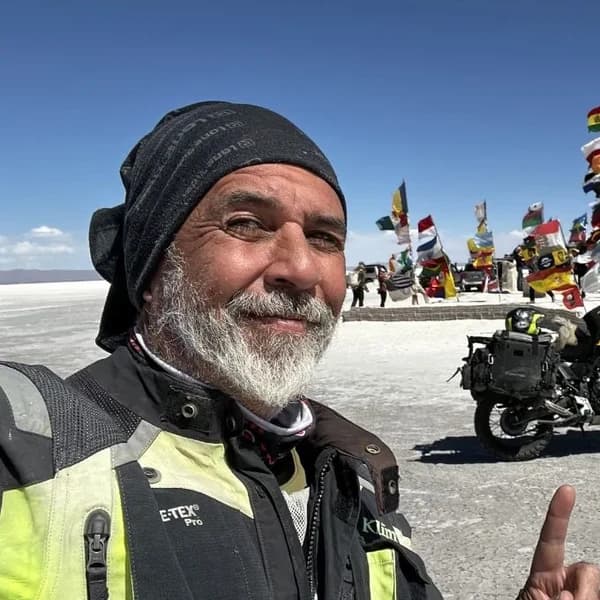
Gustavo Correa
Moto traveler, author and motorcycle travel consultant. 110,000+ km across 4 continents with Gloria, my motorcycle. Everything you read here has been tested on the road, not in an office.
Read my story →Last verified: 2026-08-30
A GIFT FOR BEING HERETHE ADVENTURE OF LIVING FREE
Do fear or doubt paralyze you before starting any project? You're not alone — every one of us has been there.
As a thank-you for visiting my site, I'm giving you my book "The Adventure of Living Free". A manual built to bring some light through the shadows and show you the philosophy that has let me ride the world for years.
* PDF STRAIGHT TO YOUR INBOX. NO SPAM.