MOTORCYCLE TRAVEL IN Italy
QUICK ANSWER
Italy has no real border checkpoint if you enter overland from a Schengen neighbor — France, Switzerland, or Austria — since Schengen functions as a single territory without internal border controls. The key issue isn't the crossing itself but insurance: if your motorcycle is registered in the EU, EEA, or Switzerland it's already covered automatically, but a plate from outside that zone (most of Latin America) needs a Green Card or a frontier policy sorted before you hit the road, because there's no office to buy one at an unmanned mountain pass.
WHAT YOU NEED TO KNOW
The country you're about to enter has particularities you need to know.
Before you cross the border there are four things you need locked down: how safe the country is, what insurance is mandatory for your motorcycle, where you'll actually find fuel, and when to go. None of these are optional.
SAFETY: LOW RISK (2/5)
Is Italy safe to enter by motorcycle? Yes — low risk of violence, the real issue is theft of motorcycles and luggage, concentrated in specific spots.
AREAS TO AVOID
- Naples and its province (Campania): The Italian region with the most vehicle theft: over 24,250 cars and motorcycles stolen in one year in the province of Naples, with more than 5,400 motorcycles and mopeds stolen.
- Autostrada service areas (autogrill), especially in the north: Organized gangs use signal jammers to prevent the vehicle from locking and steal luggage while the rider is resting, specifically targeting foreign plates.
- Historic center of Rome and Palermo: Palermo leads motorcycle theft in Italy with 168.2 reports per 100,000 residents, ahead of Naples (155.4) — opportunistic theft of motorcycles and scooters parked on the street is also common in Rome's historic center, especially at night.
WHERE TO PARK
- Parking: In tourist areas of Naples, Rome, or Palermo, avoid leaving the bike on the street overnight if you can access a gated lot or your lodging's garage; in the rest of the country, street parking is common and fine.
- Alarm: An extra disc lock or chain beyond the factory one is recommended nationwide and essential in the south (Naples, Palermo) and in major tourist cities.
- Luggage: Never leave bags, soft panniers, or valuables in sight at autostrada autogrill stops — organized gangs operate there specifically targeting foreign plates.
- Visibility: Park on streets with foot traffic and good lighting; avoid the alleys of Naples' historic center at night.
TIPS
- ➜Always use an extra disc lock or chain, even for short stops, in Naples, Rome, and Palermo.
- ➜At autostrada service areas (autogrill), keep your luggage in sight and don't rely only on the remote lock — physically check that the bike is actually locked.
Outside those specific spots, Italy is one of the safest countries in Europe to ride through — the real risk is opportunistic theft of parked bikes and luggage, not violence.
MANDATORY INSURANCE: Green Card (International Motor Insurance Card)
If your motorcycle is registered in the European Union, the European Economic Area, or Switzerland, your liability insurance already covers you automatically in Italy under the EU motor insurance directive — no Green Card or extra paperwork needed. If it's registered outside that zone (the case for most Latin American plates), you need the Green Card issued by your home insurer before traveling, or a frontier policy bought on entry (known as the carta rosa), valid from 15 days to 6 months and more expensive than the Green Card.
FUEL: AMONG EUROPE'S PRICIEST
Gasoline in Italy runs around 2 euros per liter (August 2026), among the priciest in Europe, and on the autostrada it can top 2.60 euros. The station network is dense and there's no availability problem anywhere in the country — the challenge is the price, not scarcity.
BEST SEASON: APR-JUN & SEP-OCT
April to June and September to October are the best windows: mild weather, the Dolomites passes are already open (the season starts mid-June), and far less tourist traffic than July-August. Avoid November to May in the Dolomites, where passes like the Giau or Falzarego stay closed or snowed in. On the Amalfi Coast, July and August are packed with tour buses; April-May and September offer the same road with a fraction of the traffic.
ENTERING ITALY BY MOTORCYCLE
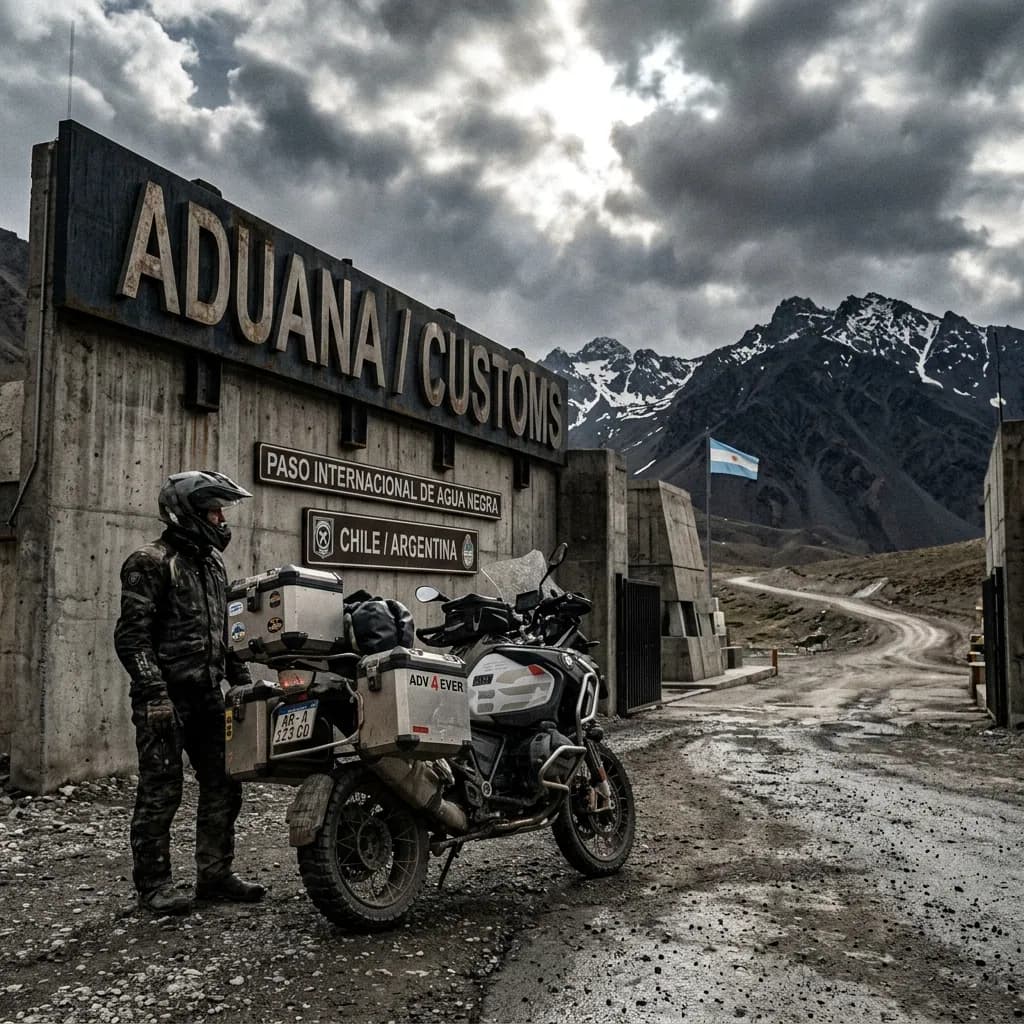
Entering Italy overland from a Schengen neighbor is nothing like crossing a border in South America — there's no checkpoint at all, since Schengen functions as a single territory without internal border controls. The real procedure, according to EU customs rules and traveler accounts on Mad or Nomad and ADVrider, happens elsewhere: at the first port or airport where you enter the Schengen area, if you're arriving from outside Europe.
The process breaks down into two possible steps, depending on how you arrive:
Schengen land border: If you cross from France, Switzerland, or Austria there's no border control or passport stamp — the Schengen area has no internal borders.
Temporary admission at customs: If you entered by plane or ship from outside Europe, the real procedure happens at that first port or airport: that's where you declare the motorcycle for temporary admission, up to 6 months without paying taxes or duties.
Temporary admission of the motorcycle is free — EU customs rules exempt it from taxes and duties for the first 6 months if you're normally resident outside the EU customs territory.
Real friction point:unlike South America, Italy (and the whole Schengen area) has no actual border post at the land crossings with France, Switzerland, or Austria — no checkpoint, no stamp, no office to sort anything out on the spot.
The practical consequence: insurance (Green Card or frontier policy) has to be sorted BEFORE you hit the road, because there's no guarantee of finding anywhere to buy it at an unmanned mountain crossing.
REQUIRED DOCUMENTATION
Passport: Valid for the whole length of your stay.
Driving license + International Driving Permit (IDP): Your home country's license is enough, but an IDP is strongly recommended for non-EU riders — it avoids issues at a traffic stop.
Motorcycle title/registration: If you're not the owner, you need notarized power of attorney from them.
Green Card or frontier policy: Mandatory insurance for motorcycles registered outside the EU/EEA/Switzerland — see the insurance section below.
Temporary admission document: Only if you entered by plane or ship from outside the Schengen area — issued by customs at the first port or airport of entry.
With these documents sorted, entering Italy with a motorcycle is, in practice, entering the whole Schengen area: once inside, you cross into France, Switzerland, or Austria without any further formality. The one point that genuinely needs planning ahead is insurance, since there's no border office where you can sort it out on the spot.
DAILY BUDGET
This price range combines cheap lodging, cooking your own meals, and basic bike maintenance — the three categories that weigh most on any moto traveler's daily budget.
Your real daily budget is something you build yourself, based on your own needs and limits — but if you want an idea of how to build yours, pick a category to see the full guide:
Full cost breakdown in the budget guide
THE 10 BEST MOTORCYCLE ROUTES IN ITALY
This Top 10 is ordered by real-world fame, from highest to lowest: at the top are the routes that any international motorcycle traveler finds first when searching "motorcycle route Italy" — the ones that show up again and again on Horizons Unlimited, ADVrider, motorcycle travel blogs and specialized rankings like Top Gear's. Further down are routes just as real and well-ridden, but with a somewhat more niche profile within the motorcycle travel community.
The Dolomites pack so many cult-status passes into such a small radius that they appear three times on this list — the Sella Ronda circuit, the historic Great Dolomites Road, and the technical Passo di Giau — but each is a distinct route, with its own history and its own riding character, the same way the Passo dello Stelvio and the Passo Gavia are kept separate even though both sit in the Lombard Alps.
Before heading out to cross passes above 2,700 meters like the Stelvio or the Gavia, it's worth checkingthe gear guide for long motorcycle trips, because the cold at altitude in the Italian Alps shows up even in the middle of summer.
And on routes like the Passo del Mortirolo or the Passo Gavia, where there's no repair shop around the corner, it always helps to reviewthe mechanics guide for long motorcycle tripsbefore heading out.
Passo dello Stelvio:the Queen of the Alps by Motorcycle
Prato allo Stelvio to Bormio, on the border of South Tyrol and LombardyClimbing the Passo dello Stelvio by motorcycle means tackling the most photographed mountain road on the planet: 2,757 meters above sea level, the highest paved pass in the Eastern Alps.
The eastern side, from Prato allo Stelvio, climbs through 48 numbered hairpin bends in just 24.3 km, a route designed by engineer Carlo Donegani and built between 1820 and 1825 to connect the Austrian empire with Lombardy.
BBC's Top Gear crowned it Europe's greatest driving road, before Jeremy Clarkson handed the title to Romania's Transfagarasan — a debate that still splits motorcycle travelers worldwide.
WARNINGS FOR THIS ROUTE
This is what you need to sort out before riding this route.
- 01Fuel range
Good. There are stations in Bormio and Prato allo Stelvio on both ends; at the summit there are only tourist kiosks, no fuel pump.
- 02Extreme congestion from buses and cyclists on the hairpins
In peak season all 48 hairpins fill up with tour buses and road cyclists climbing at the same time — several motorcycle travelers report having to wait for a bus to complete a multi-point turn in a single tight bend.
The Amalfi Coast:the Road of a Thousand Curves
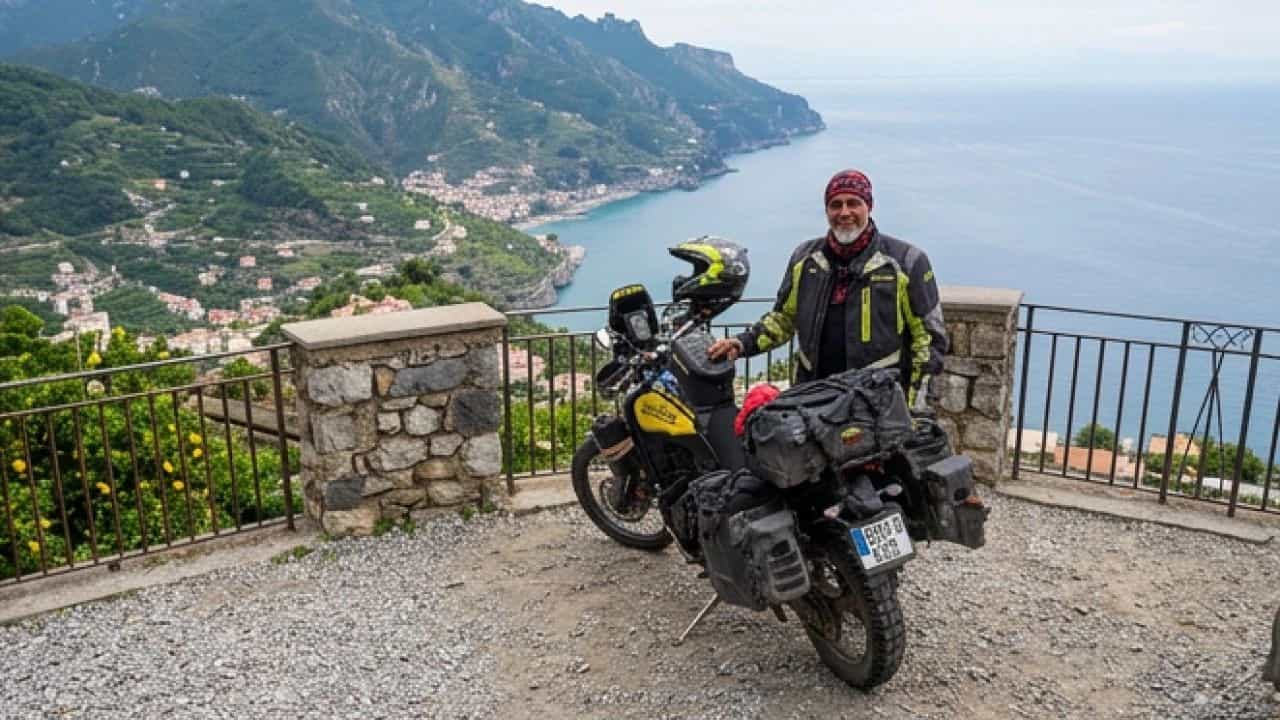
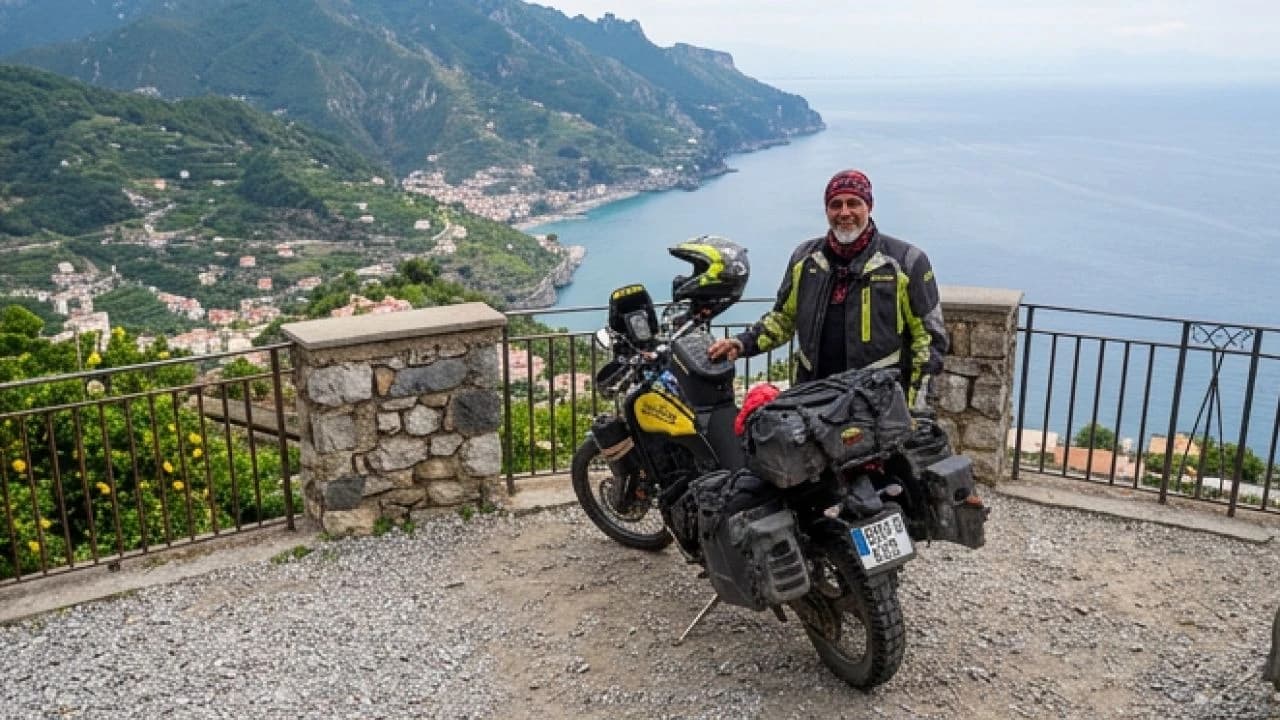
Campania coast, between Sorrento and SalernoRiding the Amalfi Coast by motorcycle means taking the SS163, the coastal road that National Geographic and dozens of travel magazines rank among the most beautiful in the world, ever since Italy turned it into a scenic touring route in the 19th century.
It's barely 50 km between Sorrento and Salerno, but the route hides more than a thousand curves carved literally into the cliffside of the Tyrrhenian coast, with Positano, Amalfi and Ravello hanging over the sea at every turn.
UNESCO declared the whole coast a World Heritage Site in 1997, recognizing a landscape where terraced lemon groves, medieval villages and tight bends combine without the road ever gaining an extra meter of width.
WARNINGS FOR THIS ROUTE
This is what you need to sort out before riding this route.
- 01Fuel range
Good in the towns (Positano, Amalfi, Vietri sul Mare); avoid running low between towns, stations are not frequent along the cliffside stretches.
- 02Tour buses on blind curves with zero margin
The SS163 is narrow and was designed in the 19th century, long before today's tour buses existed — in peak season dozens of large buses cross the route every hour, and several blind curves force vehicles to pass almost body-to-body. Slow to a crawl on every blind bend.
The Sella Ronda Circuit:the 4 Dolomite Passes
Trentino, South Tyrol and Veneto (Val Gardena, Val di Fassa, Alta Badia, Arabba)The Sella Ronda circuit by motorcycle links four passes around the Sella massif in a single closed 55 km loop: Passo Sella (2,244 m), Passo Gardena (2,121 m), Passo Campolongo (1,875 m) and Passo Pordoi (2,239 m), the highest paved pass in the entire Dolomites.
In winter, this same route becomes the most famous ski circuit in the Alps, which means the road infrastructure, mountain huts and signage are of exceptional quality for motorcycle travelers.
Each pass has its own character: the Pordoi offers the most panoramic view of the Marmolada glacier, while the Gardena delivers the best silhouette of the Sella group's rock spires at sunset.
WARNINGS FOR THIS ROUTE
This is what you need to sort out before riding this route.
- 01Fuel range
Good. Stations in the base towns of each valley (Selva di Val Gardena, Canazei, Corvara, Arabba); no fuel pumps at the summits.
The Great Dolomites Road:from Bolzano to Cortina
South Tyrol, Trentino and Veneto (SS48, Bolzano to Cortina d'Ampezzo)Riding the Great Dolomites Road by motorcycle —known in Italian as the SS48— means following the very first road that opened the Dolomites to motorized tourism: it was built between 1901 and 1909 for the Austro-Hungarian empire, back when South Tyrol still belonged to Austria.
The project was considered an engineering feat for its time, since it connected valleys that previously could only be reached on foot or by mule, and it immediately appeared in Europe's earliest motor-touring guidebooks.
Today, its 110 km between Bolzano and Cortina d'Ampezzo remain the backbone connecting nearly every other famous pass in the region, including the Pordoi and the Falzarego.
WARNINGS FOR THIS ROUTE
This is what you need to sort out before riding this route.
- 01Fuel range
Excellent. It's the route with the most towns and service stations in this entire Top 10 — never more than 20-30 km without a fuel pump.
Passo Gavia:the Wild Pass of the Giro d'Italia
Lombardy, between Bormio/Valfurva and Ponte di LegnoCrossing Passo Gavia by motorcycle means climbing to 2,618 meters on a road that, until 1960, was little more than a dirt track for military mules, with no protective barriers of any kind.
Giro d'Italia race director Vincenzo Torriani added it to the race that year, and the road wasn't fully paved until the year 2000 — it still keeps single-lane stretches carved into the rock today.
June 5, 1988 is etched into cycling history: a snowstorm buried that year's Giro stage under half a meter of snow and temperatures of -5°C, remembered as one of the most brutal days ever raced.
WARNINGS FOR THIS ROUTE
This is what you need to sort out before riding this route.
- 01Fuel range
Limited. No fuel pump at the summit or on the high stretch — fill up in Bormio or Ponte di Legno before climbing.
- 02Single-lane stretches with no guardrail
Several sections near the summit still have just one lane carved into the rock, with no guardrail toward the drop-off — sound your horn on blind curves and be ready to reverse if a vehicle appears head-on.
Strada della Forra:the Eighth Wonder of Lake Garda
Tremosine sul Garda, Lombardy (western shore of Lake Garda)Climbing the Strada della Forra by motorcycle is just 6 km, but it's the single most-cited stretch of road on all of Lake Garda: a road that literally burrows into the mountain, following the gorge the Brasa stream carved out over thousands of years.
It opened on May 18, 1913, and that very day a German correspondent described it as one of the most beautiful roads in the world — Winston Churchill went on to call it the eighth wonder.
Its fame jumped to the big screen in 2008, when the James Bond production team used it as the setting for a car chase in "Quantum of Solace," filming inside its tunnels and horseshoe bends carved straight into the living rock.
WARNINGS FOR THIS ROUTE
This is what you need to sort out before riding this route.
- 01Fuel range
Excellent. Stations are minutes away in Gargnano and Limone sul Garda, on the lakeshore.
- 02Single-lane tunnels with two-way traffic
Much of the ride passes through tunnels and galleries so narrow that only one vehicle fits at a time — some points have a traffic light and others require simply peeking in and yielding before entering, which gets tricky when a tour bus is coming the other way.
Passo di Giau:the Most Technical Pass in the Dolomites
Veneto, between Cortina d'Ampezzo and Colle Santa LuciaRiding Passo di Giau by motorcycle from the Selva di Cadore side means climbing 9.9 km at an average 9.3% grade (with sections up to 14%) spread across 29 hairpin bends, one of the climbs that made the Giro d'Italia famous.
Unlike other passes in the area, Giau reaches its summit without a village or heavy development — just a mountain lodge surrounded by alpine meadows, with the rocky Dolomite peaks as a backdrop.
Several motorcycle-focused blogs single it out as the pass that separates the tourist from the motorcycle traveler: its technical curves and minimal signage reward riders who already know how to handle a mountain road.
WARNINGS FOR THIS ROUTE
This is what you need to sort out before riding this route.
- 01Fuel range
Good. Stations in Cortina d'Ampezzo and Selva di Cadore, at both ends of the pass.
SS125 Orientale Sarda:Sardinia's Route 66
Sardinia, Dorgali–Baunei–Arbatax section (east coast)Riding the SS125 Orientale Sarda by motorcycle between Dorgali and Baunei means crossing 49 km of curves that several driving-focused publications have called the best road in the world, long before Sardinia became a popular motorcycle destination.
The route climbs and drops constantly above the Gulf of Orosei, crossing points like the Genna Ramene Pass and Monte Lopene, with Tyrrhenian Sea views found nowhere else in Italy.
Unlike the Dolomites or the Stelvio, this route stays practically empty even in shoulder season — the motorcycle traveler who rides it often has entire kilometers of perfect curves all to themselves.
WARNINGS FOR THIS ROUTE
This is what you need to sort out before riding this route.
- 01Fuel range
Scarce in the middle stretch. Fill up in Dorgali or Baunei — there are long stretches between them with no towns at all.
- 02Loose rocks on the road after rain or strong wind
On sections carved into the rock, persistent rain or strong wind can dislodge stones and even large boulders that end up directly on the pavement — slow down after any recent storm, especially on blind curves.
Chianti and Val d'Orcia:Tuscany by Motorcycle
Tuscany, between Florence, Siena, Montalcino and PienzaRiding Chianti and Val d'Orcia by motorcycle along the Via Chiantigiana (SR222) is the exact opposite of an Alpine pass: gentle vineyard-covered hills, wide curves between cypress trees, and no elevation change demanding extreme technique.
The road crosses the towns that give Chianti Classico its name —Greve in Chianti, Radda in Chianti— before dropping into the Val d'Orcia, declared a UNESCO World Heritage Site in 2004 for preserving its Renaissance-era agricultural landscape almost intact.
The row of cypress trees near San Quirico d'Orcia, along the road known as Strada della Foce, is one of the most photographed images in all of Italy — and riding it by motorcycle, with no car glass in the way, is how most motorcycle travelers recommend experiencing it.
WARNINGS FOR THIS ROUTE
This is what you need to sort out before riding this route.
- 01Fuel range
Excellent. It's the route with the most towns in this entire Top 10 — never more than 15-20 km without a service station.
Passo del Mortirolo:Europe's Toughest Climb
Lombardy, between Mazzo di Valtellina and Monno (Valtellina–Val Camonica)Climbing Passo del Mortirolo by motorcycle is just 12.5 km from Mazzo di Valtellina, but with an average gradient over 10% and sections up to 18%, it's considered by many the toughest paved climb in Europe.
For decades it was little more than a secondary dirt road called Passo della Foppa; only in 1990 did the Giro d'Italia add it to the race, looking for a lower-altitude alternative to the traumatic 1988 Gavia stage.
Its legend was sealed in 1994, when a young Marco Pantani launched a solo attack on this climb in one of cycling's most remembered breakaways — today there's a monument to "the Pirate" at the top of the pass, and motorcycle travelers from around the world ride up just to touch it.
WARNINGS FOR THIS ROUTE
This is what you need to sort out before riding this route.
- 01Fuel range
Good. Stations in Mazzo di Valtellina and in Monno/Edolo, at each end of the pass.
- 02Narrow road with hairpins at 18% grade
Much of the climb was historically a single-lane road with no guardrail; today it's paved but keeps its original width in several stretches — with gradients up to 18% on the bends, any oncoming vehicle forces very tight maneuvering.
NEIGHBORING COUNTRIES
Crossing the border next? Click a country to see its 10 best motorcycle routes.



FREQUENTLY ASKED QUESTIONS
01Do I need a Carnet de Passage to enter Italy with my motorcycle?
+
Do I need a Carnet de Passage to enter Italy with my motorcycle?
No. The European Union doesn't require one (neither do Switzerland or Norway) — your motorcycle's ownership documents, your passport, and valid insurance are enough. A Carnet de Passage only applies in a handful of specific cases, like taking part in an organized track event.
02What is a ZTL and how does it affect motorcyclists?
+
What is a ZTL and how does it affect motorcyclists?
Zona a Traffico Limitato: over 300 Italian historic centers restrict vehicle access, enforced by cameras. Motorcycles are usually exempt, but the rule varies city by city (in Florence, for example, they can enter and park) — check local signage before riding in. Fines run from 80 to 300 euros per recorded entry.
03Can any motorcycle ride on the Italian autostrada?
+
Can any motorcycle ride on the Italian autostrada?
No. Motorcycles under 150cc are banned from Italy's autostrada — they're limited to state and provincial roads, which tend to be the more interesting ones for a motorcycle traveler anyway.
04Is lane splitting legal in Italy?
+
Is lane splitting legal in Italy?
There's no explicit law permitting or banning it. It's widely practiced in cities like Rome or Naples and tolerated by police in slow-moving traffic, but aggressive or high-speed filtering can result in a dangerous-driving citation.
05How long can I stay in Italy with a motorcycle registered outside the EU?
+
How long can I stay in Italy with a motorcycle registered outside the EU?
Up to 6 months under the EU's temporary admission regime, tax and duty free, as long as you're normally resident outside the EU customs territory. The limit applies to the whole Schengen area, not just Italy.
06Do I need a Green Card if my motorcycle is already insured at home?
+
Do I need a Green Card if my motorcycle is already insured at home?
It depends on where it's registered. If it's in the EU, the EEA, or Switzerland, your insurance already covers Italy automatically under the European insurance directive. If it's registered outside that zone (the case for most Latin American plates), you do need a Green Card from your home insurer or a frontier policy bought on entry.
07Is it safe to leave a motorcycle parked on the street in Italy?
+
Is it safe to leave a motorcycle parked on the street in Italy?
Generally yes, but with real exceptions: Naples and its province record the highest absolute number of motorcycle and scooter thefts in Italy, with over 5,400 units stolen a year (Palermo, in fact, has the highest per-capita theft rate in the country). An extra lock and avoiding overnight street parking in those areas cuts the risk significantly.
Want to ride the Amalfi Coast on your own?
Everything on this page is free and will help you plan the trip. If you want the route loaded on your GPS and fully mapped out ahead of time, the paid guide bundles the GPX track, checklist, lodging and mechanics into a single PDF.
SEE THE ROUTE GUIDE WITH GPX TRACK →
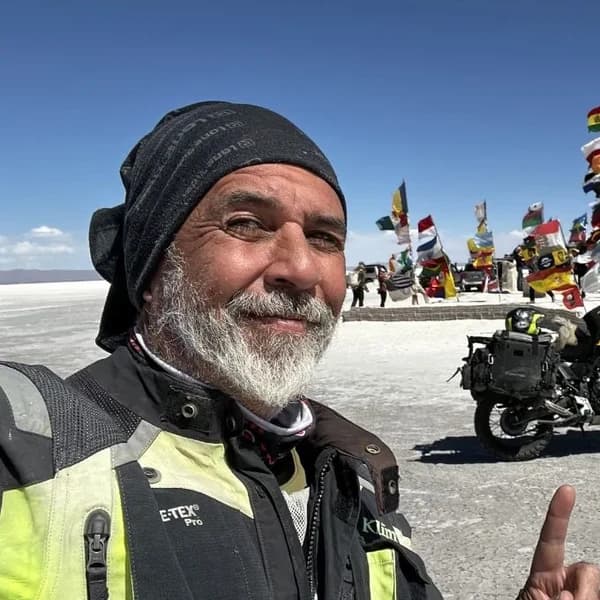
Gustavo Correa
Moto traveler, author and motorcycle travel consultant. 110,000+ km across 4 continents with Gloria, my motorcycle. Everything you read here has been tested on the road, not in an office.
Read my story →Last verified: 2026-08-29
Sources consulted (26)+
- mibi.ie
- bennetts.co.uk
- acem.eu
- sicurauto.it
- infoassicurazionisulweb.it
- eur-lex.europa.eu
- zoll.de
- evz.de
- autoeurope.eu
- tuscanymotorcyclerentals.com
- moto.it
- vesuviolive.it
- ilmattino.it
- diariofvg.it
- isitsafetotravel.org
- motocalifornia.com
- advrider.com
- globalpetrolprices.com
- euronews.com
- italymototours.com
- motoworldexplorer.com
- riders-atlas.com
- italygo.org
- vanever.com
- madornomad.com
- partireper.it
A GIFT FOR BEING HERETHE ADVENTURE OF LIVING FREE
Do fear or doubt paralyze you before starting any project? You're not alone — every one of us has been there.
As a thank-you for visiting my site, I'm giving you my book "The Adventure of Living Free". A manual built to bring some light through the shadows and show you the philosophy that has let me ride the world for years.
* PDF STRAIGHT TO YOUR INBOX. NO SPAM.